Quantum Tunneling: Understanding Energy Barriers and Scanning Tunneling Microscopy
This article explores the concept of quantum tunneling, where kinetic energy enables particles to overcome potential energy barriers. It discusses how less energetic objects cannot traverse high potential regions and highlights the critical thresholds of energy for success or failure in tunneling. The phenomena of wave duality allow particles to behave as waves, facilitating their entrance into barriers with decreased intensity. Additionally, the article covers the limitations of optical and electron microscopes and introduces scanning tunneling microscopy (STM), which utilizes tunneling currents to achieve atomic-resolution imaging.


Quantum Tunneling: Understanding Energy Barriers and Scanning Tunneling Microscopy
E N D
Presentation Transcript
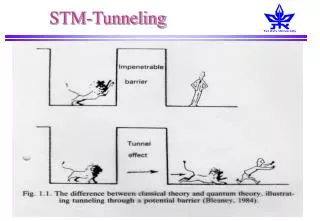
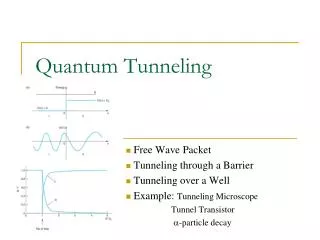
Kinetic energy is used to overcome potential energy. More for motion past barrier Less creates turning point Objects with less energy should not cross high potential regions. E1 < U0 failure E2 > U0 success Energy Barrier x1 x2 E2 U0 E1
Wave duality permits particles to behave as waves. Waves can enter a barrier but lose intensity on entry. Exponential decrease Depends on energy U0-E Depends on barrier width w Reduced amplitude reflects the probability of barrier penetration. Quantum Wave U0 A0 Aw w
Optical microscopes are limited by light diffraction. About 500 nm Electron microscopes are also diffraction-limited. Debroglie wavelength About 0.2 nm Tunneling between a sharp tip and sample measures gap. Resolves 0.001 nm About 1% of atomic diameter Tunneling Probe
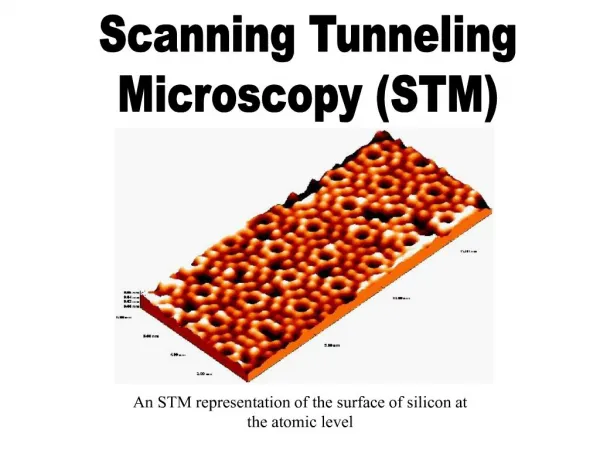
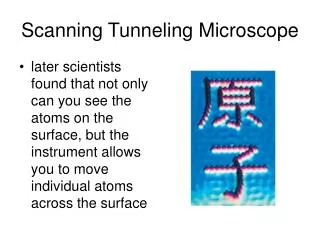
A scanning tunneling microscope (STM) uses a tunneling current to make images of atoms. STM 7 nm x 7 nm image: Cs atoms on GaAs (NIST) next