Understanding Cardio: Heart Health, Blood Pressure, and Exercise Principles
Cardio refers to activities that elevate your heart rate, working your heart and improving cardiovascular health. Blood circulates through arteries and veins, with your body containing about 6 liters of blood. Important metrics include your Resting Heart Rate (RHR) and Recovery Heart Rate, providing insight into cardiovascular fitness. Knowing blood pressure (systolic and diastolic) is crucial as well. Understanding risks like inactivity and obesity can mitigate cardiovascular disease, which is a leading cause of death. Emphasize principles of overload, progression, and specificity in your training regimen for optimal heart health.


Understanding Cardio: Heart Health, Blood Pressure, and Exercise Principles
E N D
Presentation Transcript
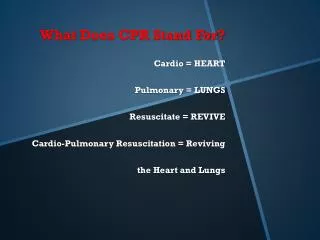
Cardio Definition: an activity that works your heart
The heart Arteries carry the blood out of the heart (with oxygen) Veins carry the blood back into the heart (without oxygen) Your body holds about 6 litres of blood
Blood travels from the arteries, to the capilleries to the veins
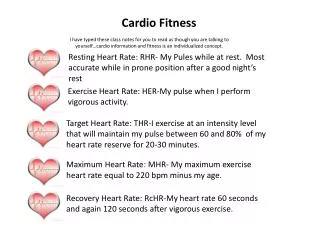
Heart rates • Your Resting Heart Rate (RHR) is your pulse at rest • Your Recovery Heart Rate is your pulse after and activity when your body goes back to normal. It should be at 120 BPM 5-6 minutes after your activity. It should be 100 BPM 10 minutes after the activity
Blood pressure • Systolic pressure (when the blood is pumped out of your heart) • Diastolic pressure (when the heart is relaxed) • Your pressure should be 120 over 80 • + or – 20 for systolic and + or – 10 for diastolic is ok
Cardiovascular disease • The primary cause is a build up of fatty deposits in the inner walls of the arteries • This is called atherosclerosis • What do you think some risk factors are? • Inactivity, obesity, smoking, high blood pressure, stress, female/male, high cholesterol, age, heredity • Heart related illnesses cause 40% of deaths in Canada
Overload • How would you use the overload principle for cardio? • Frequency? • Intensity? • Time?
Target heart rate (intensity) 220-your age = MHR (max heart rate) MHR-RHR = A A x 60% = B B + RHR = lower limit of target zone To get your higher limit, do the same thing but multiply A by 90%
Progression & Specificity • How do you apply the principle of progression to cardio? • There are two types of exercise that use oxygen: aerobic and anaerobic • Aerobic: uses oxygen and can be done for at least 15 minutes without gasping for breath. Examples? • Anaerobic: uses oxygen faster than you can replenish it. Can only be done for a short period of time
Wrap-up • Study questions on page 115 • Discussion questions on page 117