Download
1 / 11
110 likes | 228 Vues
Explore Earth's intriguing history and formation through its geologic timeline and composition. This guide delves into two models of Earth's layers: based on rock strength—Lithosphere, Asthenosphere, Mesosphere, Outer Core, and Inner Core; and on composition—Continental Crust, Oceanic Crust, Mantle, and Core. Learn about gravitational separation and planetary accretion processes. Discover the increasing density and different elemental compositions that shaped our planet. Be prepared for next week's lab on minerals and how to make a planet!

E N D
EPS 102LLab 2: Earth History Today: - Geologic timeline - Earth’s composition - Next week: Minerals - Turn in lab 1!
How to make a Planet: Step 1: Planetary Accretion From a cloud of dust to a little marble Step 2: Gravitational Separation Materials with a high density tend to sink through lighter materials http://www.astro.psu.edu/users/niel/astro1/slideshows/class43/slides-43.html http://www4.nau.edu/meteorite/Meteorite/Book-GlossaryD.html
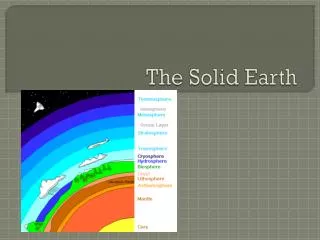
Composition of the Earth Two Models for the Composition of the Earth 1.) Layers of different rock strength • Lithosphere • Asthenosphere • Mesosphere • Outer Core • Inner Core Increasing Density
Composition of the Earth Two Models for the Composition of the Earth 2.) Layers of different composition • Continental Crust • Oceanic Crust • Mantle • Core Increasing Density
Core: iron, nickel Mantle: iron, nickel, magnesium Crust: silica, oxygen, aluminum, some iron Inner core: solid Outer core: liquid Mesosphere: hot, rigid Asthenosphere: plastic, deforms easily Lithosphere: cool, rigid COMPOSITION vs. STRENGTH Controlling factor: differentiation during Earth formation according to elemental mass Controlling factors: temperature and pressure increase from surface to interior
Burgess Shale-Precambrian Stephen Jay Gould: Wonderful Life 1989