Kingdom Protista
Kingdom Protista. Kingdom Protista. All members of this Kingdom, are unicellular or very simple multicellular organisms. Members of this kingdom have been around for about 1.5 billion years. Categories of Kingdom Protista.

Kingdom Protista
E N D
Presentation Transcript
Kingdom Protista • All members of this Kingdom, are unicellular or very simple multicellular organisms. • Members of this kingdom have been around for about 1.5 billion years.
Categories of Kingdom Protista • There are two major categories; the protozoa (animal-like) and the protophyta (plant-like)
General Characteristics of the Protozoa • 1. One -celled • 2. Eukaryotic • 3. Shape determined by the cell membrane or a thicker, elastic membrane called the pellicle. • 4. Reproduce asexually and sexually. • 5. Aquatic
General Characteristics of the Protozoa continued • 6. Heterotrophic • 7. Many are motile-use cilia, flagella or pseudopodia. • 8. Important role in food chain and in the decay process. • 9. Dormant protozoa are called cysts. • 10. Two famous protozoa are the paramecium and the amoeba.
General Characteristics of the Protophyta • 1. One -celled, filaments and colonies. • 2. Eukaryotic • 3. Shape determined by cell wall. • 4. Reproduce asexually and sexually. • 5. Aquatic • 6. Phototrophic • 7. Motile by cilia or drift in water.
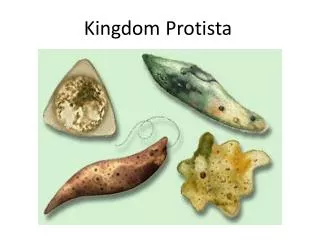
General Characteristics of the Protophyta continued. • 8. Known for their role in the food chain and for their contribution to the Earth’s oxygen supply. • 9. Dormant cells are called spores. • 10. Two of the most famous protophyta are the Euglena and diatoms.
The Ameba • The common amoeba, Amoeba proteus, belongs to the phylum known as Sarcodina. • It lives in fresh water. • It is an independent cell, with a nucleus and cytoplasm. • It has no permanent organelles.
The Ameba continued • Although the amoeba has a simple structure, it can move, reproduce,capture and ingest food, digest food, egest wastes, respire and respond to stimuli.
The Amoeba-Movement • Movement known as amoeboid movement. • Uses pseudopods, formed by the plasmasol and plasmagel that comprise the cytoplasm of the amoeba.
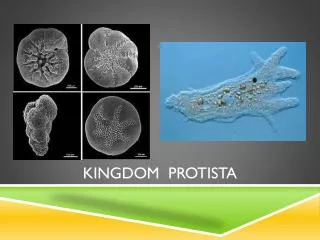
Foraminiferans • This is another group of sarcodinians. • Abundant in the oceans. • They too move by way of pseudopods. • They are surrounded by shells made up of calcium. • Eventually the remains of the shells may form chalk deposits.
The Paramecium • One of the most complex protozoa. • Unicellular • Prefers stagnant water. • Has a definite shape(unlike the amoeba). • Certain parts of the cytoplasm do certain things.
Cilia • Paramecia move by way of cilia and hence are members of phylum Ciliophora • Note the hair-like cilia on this ciliate.
Formation and Processing of Food Vacuoles • Food is swept by cilia into the cell mouth. • Food passes into the gullet and a food vacuole forms at it’s base. • Enzymes from the cytoplasm enter the vacuole to digest food. • Wastes from the vacuole are expelled through the anal pore.
Locomotion • Ciliates travel along a spiral path, with the cell rotating around it’s long axis. • A sine wave pattern forms.
The Protophyta • There are about eleven thousand species of algal protists. • They are spread over three phyla;Euglenophyta, Chrysophyta, and Pyrrophyta.
Phylum Euglenophyta • Most are unicellular, but a few are colonial. • Animal and plant-like characteristics. • Use photosynthesis to produce paramylum. • In absence of light they are heterotrophic. • Use flagella for locomotion.
Phylum Euglenophyta cont. • A contractile vacuole is present that serves to remove excess water. • The presence of a light sensitive eyespot or stigma, allows the Euglena to locate
Phylum Pyrrophyta - The Dinoflagellates • Unicellular algae. • Photosynthetic and heterotrophic. • Tough outer shell. • All have two flagella. • Reproduction is asexual. • Food stored as oil or starch.
Red Tide • From time to time,there are algal blooms and the so-called red tides form. • Toxins from the dinoflagellates are released. • Fish die from the toxin and paralytic shellfish poisoning(PSP) may occur.
Phylum Sporozoa • Members of this phylum are non-motile protozoa. • An excellent example of a sporozoan is Plasmodium vivax , the causative agent of malaria. • There are two stages involved in the life cycle of Plasmodium vivax ; Asexual(in the human) and Sexual (in the mosquito).
Phylum Sporozoa con’t. • When an infected mosquito bites a human, spores enter the bloodstream and produce gametes in the red blood cells. • When an infected human is bitten by a mosquito, gametes unite in the gut of the mosquito to form a zygote. • In the mosquito, the zygote matures into more spores which are passed on to the next human victim.
Interesting Facts About Malaria • In the days of British colonization of India, soldiers contracted malaria. • The treatment was to give the soldiers quinine mixed with water (tonic water), mixed with gin (to kill the taste). • This gave rise to a popular drink amongst the soldiers known as “Gin and Tonic”.
More Interesting Facts About Malaria • War veterans who caught malaria overseas, have had recurring episodes of this disease. • In fact, this has been observed in patients in nursing homes right here in Kings County.
The Trypanosome • Member of Phylum Mastigophora. • It is a zooflagellate. • Causative agent of African Sleeping Sickness. • Transmitted from infected wild animals by the tsetse fly to humans
Trypanosome continued • Victim develops a fever and becomes weak and anemic. • This is due to the effect of the toxic metabolites produced by this organism.
Trypanosome continued • Finally the parasites invade the fluid surrounding the brain and spinal cord, the person loses consciousness and dies. • Drugs are effective in the early stages of this disease.