Understanding Angiosperms: The Life Cycle and Characteristics of Flowering Plants
290 likes | 413 Vues
Angiosperms, or flowering plants, are vital to the ecosystem due to their reproductive structures that attract pollinators and produce fruit for seed protection and dispersal. They exhibit diverse life spans categorized into annuals, biennials, and perennials. Angiosperms are classified into two groups based on seed type: monocots (one seed leaf) and dicots (two seed leaves). Each flower contains male (stamen) and female (pistil) reproductive organs, and they undergo processes like self-pollination and cross-pollination. The double fertilization process leads to seed and fruit development, completing the life cycle.


Understanding Angiosperms: The Life Cycle and Characteristics of Flowering Plants
E N D
Presentation Transcript
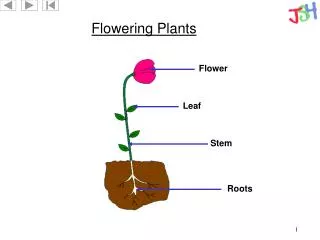
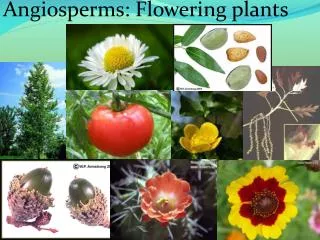
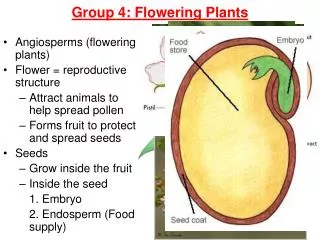
Group 4: Flowering Plants Angiosperms (flowering plants) Flower = reproductive structure Attract animals to help spread pollen Forms fruit to protect and spread seeds Seeds Grow inside the fruit Inside the seed 1. Embryo 2. Endosperm (Food supply)
Seed Dispersal • Fruit brightly colored • Attracts animals • Seeds pass through animals digestive system • Seeds pooped in a new area to grow Fruit seeds in fox poop
Angiosperm Groups • 2 groups: Based on seed type • Cotyledon: embryonic leaf • Two Categories: • Monocots: embryo with 1 seed leaf • Dicots: embryo with 2 seed leaves
Monocots vs. Dicots Know this one Know this one Know this one ehh Know this one
Apple Tree: Monocot or Dicot? 2 3 1 Net-like veins 4 5
Monocot or Dicot? 2 3 1 4 6 5
Monocot or Dicot? Veins run parallel
Monocot or Dicot? Veins run parallel
Monocot or Dicot? Veins branch outward
Angiosperm Life Spans • Three Life Span Types: • 1) Annuals • Seed grows… • Produce flowers & seeds… • Die • 2) Biennials • 1st year: • Seed grows and stores food • 2nd year: • grows more… • makes flowers & seeds… • dies • 3) Perennials • Live for more than 2 years • May take decades to grow fruit
Flowers petals sepals • Reproductive structure of angiosperms • Sepals • outer ring of leaves • protection • Petals • Inner ring of leaves • Brightly colored to attract pollinators • Male and female organs found inside
Tulip Pistil and Stamen female male
Lily Pistil and Stamen female male
Pistil and Stamen female male
Pistil and Stamen female male
Flowers • Male Stamen • Anther: produces pollen (sperm) • Female Carpel/Pistil • Inner most part • Ovary: within the base • Contains eggs • Grows into fruit when fertilized • Stigma: sticky tip, collects pollen
Cross-Pollination(pollen of one, fertilizes egg of another) . . .
Angiosperm Life Cycle 1. Pollen sticks to animal (pollinator) or is released into wind.
1. Pollen sticks to animal (pollinator) or is released into wind.
2. Animal (pollinator) finds new flower to feed on & pollen grains land on the stigma = pollination 3. Pollen tube grows towards the ovary and 2 nuclei transfer down into the ovule .. Let’s zoom in egg
4. Angiosperms go through the process of double fertilization. • 1 sperm fuse with the egg = zygote • 1 sperm fuse with the polar nuclei = triploid (3n) endosperm Double Fertilization Endosperm (3n) Zygote
Endosperm Seed Coat Embryo 5. Each ovule becomes a seed. 6. The surrounding ovary grows into a fruit.
9. Seeds get dispersed. 10. Seed germinates (sporophyte), and the cycle starts over. Ground