Understanding Scale Dynamics in Environmental Modeling: Challenges and Solutions
100 likes | 215 Vues
This discussion highlights the complexities of spatial, temporal, and functional scales in environmental modeling. It raises critical questions about functional scales, counterintuitive results, and the representation of ecosystems in models. Through the lens of participatory scenarios and integrating concepts, the text emphasizes the need for improving and combining existing techniques. It considers the implications of economic, ecological, and social factors on farmer decisions, climate change, and institutional behaviors. Ultimately, this work advocates for new approaches to model multi-scale dynamics effectively.


Understanding Scale Dynamics in Environmental Modeling: Challenges and Solutions
E N D
Presentation Transcript
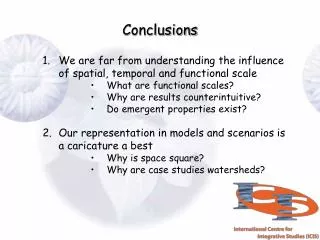
Conclusions • We are far from understanding the influence of spatial, temporal and functional scale • What are functional scales? • Why are results counterintuitive? • Do emergent properties exist? • Our representation in models and scenarios is a caricature a best • Why is space square? • Why are case studies watersheds?
The way ahead • Improve existing techniques • Combine existing techniques • Develop new integrating concepts
E E E E E E Regional National I I I S S S Local Improve and combine: Using ‘reduced form’ models Multi-scale participatory scenarios
Economic Ecological Income Prices Farmer decisions Natural vegetation Climate change Market behaviour Crop growth Institutional Social NGOs Social well-being Migration EU National government Cultural changes The modelling toolbox
E E E E Regional National I I S S Combination with toolbox information Multi-scale participatory scenarios Local Theory
Integrating Concepts • Lemniscate (Resilience Alliance) • Transition curve (IA)
Transition curve (Rotmans) Indicator Stabilisation Acceleration Take-off Predevelopment Time
Proposed solutions Wilbanks: Theoretical understanding of cross-scale dynamics Giampietro: Complex time Easterling: Self-organisation and resilience Rotmans: Transition management for sustainable development
Discussion points Does scale really matter? -- It is but common sense It will never be solved -- The scale-problem is too complicated