
Dirty Money
This experiment aimed to observe and analyze the normal microflora present on money obtained from various local establishments, including banks and businesses. We employed Trypticase Soy Broth for culturing and utilized a Hitachi 2406 Scanning Electron Microscope for imaging. Samples were treated with formaldehyde, dehydrated in ethanol series, and then sputter-coated with gold. Results indicated significant amounts and diversity of microbial life on the examined currency. This study sheds light on the potential health implications of handling cash in everyday transactions.

Dirty Money
E N D
Presentation Transcript
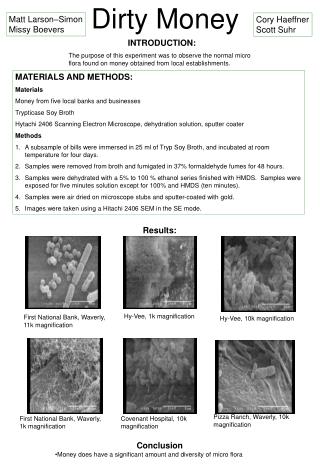
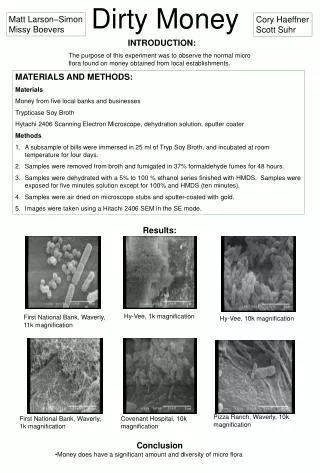
Matt Larson–Simon Missy Boevers Cory Haeffner Scott Suhr Dirty Money INTRODUCTION: The purpose of this experiment was to observe the normal micro flora found on money obtained from local establishments. • MATERIALS AND METHODS: • Materials • Money from five local banks and businesses • Trypticase Soy Broth • Hytachi 2406 Scanning Electron Microscope, dehydration solution, sputter coater • Methods • A subsample of bills were immersed in 25 ml of Tryp Soy Broth, and incubated at room temperature for four days. • Samples were removed from broth and fumigated in 37% formaldehyde fumes for 48 hours. • Samples were dehydrated with a 5% to 100 % ethanol series finished with HMDS. Samples were exposed for five minutes solution except for 100% and HMDS (ten minutes). • Samples were air dried on microscope stubs and sputter-coated with gold. • Images were taken using a Hitachi 2406 SEM in the SE mode. Results: First National Bank, Waverly, 11k magnification Hy-Vee, 1k magnification Hy-Vee, 10k magnification Pizza Ranch, Waverly, 10k magnification First National Bank, Waverly, 1k magnification Covenant Hospital, 10k magnification • Conclusion • Money does have a significant amount and diversity of micro flora















![[PDF] Dirty Money By Liliana Hart Free Downloads](https://cdn4.slideserve.com/8198417/slide1-dt.jpg)

![[PDF] Free Download Dirty Money By Denise Grover Swank](https://cdn4.slideserve.com/8331579/slide1-dt.jpg)