Understanding Inheritance Patterns in Human Genetic Disorders
This overview explores the various inheritance patterns of genetic disorders in humans, highlighting autosomal recessive and dominant traits as well as sex-linked disorders. It explains the role of alleles and chromosomes, emphasizing how most genetic conditions result from an autosomal recessive mechanism. The document discusses examples such as cystic fibrosis and hemophilia while also touching on mitochondrial inheritance and its implications for disease manifestation. Furthermore, the importance of recessive and dominant alleles in inheritance is outlined, along with concepts like incomplete dominance and codominance.

Understanding Inheritance Patterns in Human Genetic Disorders
E N D
Presentation Transcript
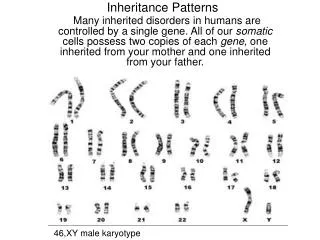
Inheritance Patterns Many inherited disorders in humans are controlled by a single gene. All of our somatic cells possess two copies of each gene, one inherited from your mother and one inherited from your father. 46,XY male karyotype
Most inherited disorders are caused by autosomal recessive alleles • Autosomes are the 22 pairs of chromosomes that are not the sex chromosomes • Alleles are all of the alternate forms of a gene (ie. B and b) • Recessive means it takes two abnormal copies to exhibit the full blown phenotype • Examples of autosomal recessive disorders are : cystic fibrosis, sickle-cell disease, PKU • A Punnet Square demonstrating inheritance of an autosomal recessive deafness is found at the right Normal Dd Normal Dd PARENTS D D Eggs Sperm DD Normal d d Dd Normal (carrier) Dd Normal (carrier) OFFSPRING dd Deaf Figure 9.9A
Examples: achondroplasia, Huntington’s disease • A few inherited disorders are caused by dominant alleles. Dominant alleles hide recessive alleles, phenotypically. Figure 9.9B
Sex-linked disorders affect mostly males • Most sex-linked human disorders are due to recessive alleles • These sex linked alleles are forms of genes found on the X chromosome. A male has only one X chromosome • Examples: hemophilia, red-green color blindness • These are mostly seen in males, but can be seen in females. • A male receives a single X-linked allele from his mother, and will have the disorder, while a female has to receive the allele from both parents to be affected Figure 9.23A
These figures illustrate inheritance patterns for white eye color (r) in the fruit fly, an X-linked recessive trait • Their inheritance pattern reflects the fact that males have one X chromosome and females have two Female Male Female Male Female Male XRXR XrY XRXr XRY XRXr XrY XR Xr XR XR XR Xr Y XRXr XRXR XRXr Y Y Xr Xr XRY XrXR XRY XrXr XRY XrY XrY R = red-eye allele r = white-eye allele Figure 9.22B-D
Incomplete dominance results in intermediate phenotypes P GENERATION Whiterr • When an offspring’s phenotype—such as flower color— is in between the phenotypes of its parents, it exhibits incomplete dominance Red RR Gametes R r PinkRr F1 GENERATION 1/2 R 1/2 r 1/2 R 1/2 R Eggs Sperm RedRR 1/2 r 1/2 r PinkRr PinkrR F2 GENERATION Whiterr Figure 9.12A
Incomplete dominance in human hypercholesterolemia (high levels of cholesterol in the blood) GENOTYPES: HH Homozygousfor ability to makeLDL receptors Hh Heterozygous hh Homozygousfor inability to makeLDL receptors PHENOTYPES: LDL LDLreceptor Cell Normal Mild disease Severe disease Figure 9.12B
Codominance-The individual expresses both phenotypes and neither is dominant.
Mitochondrial Disorders • Depletion of mtDNAInfantile myopathyFatal"Later-onset"AZT treatmentSeveral types of mtDNA defectDeafnessDiabetesExternal ophthalmoplegia (PEO)SporadicMaternalDominantRecessiveLeigh'sMyopathyRhabdomyolysisSensory neuropathySystemic disorders • mtDNA Point mutationsCardiomyopathyLeber's optic neuropathyLeigh's syndromeMELASMERRFNARP/MILSSingle deletion or duplicationAtaxia, LeukodystrophyDiabetes: Maternal inheritance Kearns-SayrePearson'sPEO: SporadicMultiple deletionsAgingMyositisInclusion bodyCOX- muscle fibersMNGIEPEOWolfram
Mitochondrial Inheritance Mitochondrial disease begins to become apparent once the number of affected mitochondria reaches a certain level; this phenomenon is called 'threshold expression'.
In class………………………. • What is the mode of inheritance of the disorder you are researching? • If you are studying a particular cell type, are there diseases associated with this cell type when it is mutated and how are those diseases inherited?