Instrument Characterization from In-Flight Data for Corot-Brazil Workshop
140 likes | 245 Vues
Explore the analysis and validation of critical instrument components based on collected data to enhance scientific modeling and reduce noise sources. Focus on CCDs, optics, and readout electronics.


Instrument Characterization from In-Flight Data for Corot-Brazil Workshop
E N D
Presentation Transcript
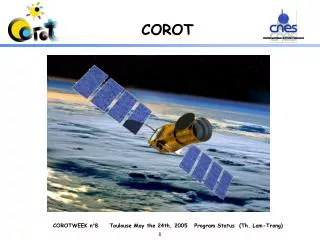
Corot Instrument Characterizationbased on in-flight collected data Leonardo Pinheiro da Silva Corot-Brazil Workshop October 31, 2004 Corot-Brazil Workshop – October 31, 2004
Introduction • Some instrument components are susceptible to physical phenomena leading to undesired effects on the scientific data • some might be corrected through modeling, with basis on correlated collected data (e.g. HK data) • others are expected to be negligible, given the defined specifications for the photometric signal Corot-Brazil Workshop – October 31, 2004
Objectives • Though the analysis and characterization of some critical aspects we intend to: • validate the theoretical models to be used on ground-based corrections • evaluate the respective modeling parameters • verify the hypothesis enabling some of the noise sources to be neglected Corot-Brazil Workshop – October 31, 2004
Some Aspects of Interest • Bias Level (Temp. of Analogic Comp.) • - Electronics’ Gain (Aging) - PSF (Temp. of the Lenses) instrument optics CCD detectors readout electronics digital processing - Spontaneous Generation of e-(CCD Temp.) - Pixel Response Non-Uniformity (+Attitude Jitter) - p+ Impacts (Geo. Position, Effective Shielding) ... Corot-Brazil Workshop – October 31, 2004
I. CCDs: Classic Characterization • Reduction of in-flight calibration data to provide: • Dark Fields • Bright pixels map • Dark current law as f(T) • Flat Fields • Black pixels map • Local PRNU statistics Corot-Brazil Workshop – October 31, 2004
CCDs: p+ Flux at the Focal Plane • CCDs are susceptible to radiation which depends: • on the satellite position in orbit • on the effective shielding • Effect on the photometry will depend on: • the energy of incoming impacts (generated e-) • the impacted area of the CCD (disturbed pixels) • Specific tools to characterize: • incoming impacts as a function of satellite coordinates • impact effects on the CCD (energy and scale statistics) Corot-Brazil Workshop – October 31, 2004
(…) (…) CCDs: p+ Flux at the Focal Plane • Set of images + satellite orbit data => p+ flux (lat, lon) [p+/cm2/s] (lat,lon) Corot-Brazil Workshop – October 31, 2004
II. Optics: Spread Function • Collected star light is spread over a region of the detector’s surface • distribution profile depends on stellar magnitude and type, position in the field of view, lenses’ temperature, .. • Knowledge about the spread function is useful in jitter corrections and star coordinates evaluation • Specific tools to estimate: • high-resolution (sub-pixel) spread functions, given a set of images and corresponding satellite attitude data Corot-Brazil Workshop – October 31, 2004
Spread Function: Sampled Data projected image acquired data spline interpolation Corot-Brazil Workshop – October 31, 2004
? Spread Function: Data Acquisition attitude jitter spatial sampling (m=6; T=6000K) restituted image Corot-Brazil Workshop – October 31, 2004
Spread Function: Restitution projected image typical sample restituted image Corot-Brazil Workshop – October 31, 2004
III. Readout Electronics • Signal conditioning is done between the CCD outputs and A/D conversion • Signal is amplified, an offset is imposed • Components are sensitive to thermal fluctuations and aging • Specific tools to characterize the behavior of: • the offset level • the electronic gain • the readout noise Corot-Brazil Workshop – October 31, 2004
Example: Electronic Bias • Correlation to T probes, thermal sensitivity, temporal evolution, spectra, .. Astero 1L Exo 1L Astero 2L Exo 2L Corot-Brazil Workshop – October 31, 2004
Conclusion • Data processing algorithms have been developed with basis on available in-flight data and calibration requirements • The set of algorithms has been integrated in a mock-up and will soon be migrated to an operational structure • Further work is to be done on other instrument aspects which might also be interesting to characterize... Corot-Brazil Workshop – October 31, 2004