Understanding Earth's Spheres and Meteorological Processes
This comprehensive overview explores the study of meteorology, examining the atmosphere and the processes that shape weather and climate. It discusses the formation of our solar system under the nebular hypothesis, the significance of Earth's four major spheres – the hydrosphere, atmosphere, geosphere, and biosphere – and their interactions. The concepts of destructive and constructive forces affecting Earth's surface, including weathering, erosion, and plate tectonics, are also covered, providing a foundational understanding of Earth's geological dynamics.

Understanding Earth's Spheres and Meteorological Processes
E N D
Presentation Transcript
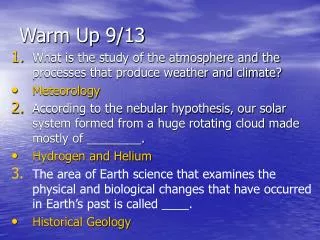
Warm Up 9/13 • What is the study of the atmosphere and the processes that produce weather and climate? • Meteorology • According to the nebular hypothesis, our solar system formed from a huge rotating cloud made mostly of ________. • Hydrogen and Helium • The area of Earth science that examines the physical and biological changes that have occurred in Earth’s past is called ____. • Historical Geology
A View of Earth Chapter 1, Section 2
Earth’s Major Spheres • Earth can be thought of as consisting of four major spheres: the hydrosphere, atmosphere, geosphere, and biosphere • Hydrosphere – the water portion of Earth • Atmosphere – the gaseous portion of a planet; the planet’s envelope of air • Geosphere – layer of Earth under both the atmosphere and the oceans • Because the geosphere is not uniform, it is divided into three main parts based on differences in composition—the core, the mantle, and the crust • Biosphere – all life on Earth; the parts of the solid Earth, hydrosphere, and atmosphere in which living organisms can be found
Concept Check • What are Earth’s four major spheres? • The hydrosphere, atmosphere, geosphere, and biosphere
Plate Tectonics • There are two types of forces affecting Earth’s surface • Destructive forces such as weathering and erosion work to wear away high points and flatten out the surface • Constructive forces such as mountain building and volcanism build up the surface by raising land and depositing new material in the form of lava • The theory that finally emerged, called plate tectonics, provided geologists with a model to explain how earthquakes and volcanic eruptions occur and how continents move
Concept Check • What is the difference between destructive forces and constructive forces? • Constructive forces build up the surface material, whereas destructive forces destroy surface material
Assignment • Read Chapter 1, Section 1 (pg. 2-5) • Do Section 1.1 Assessment #1-7 & Connecting Concepts (pg. 5) • Read Chapter 1, Section 2 (pg. 7-10) • Do Section 1.2 Assessment #1-9 (pg. 10)