Download
1 / 6
60 likes | 168 Vues
Explore different types of thermodynamic processes - adiabatic, isochoric, isobaric, and isothermal - with equations and diagrams for an ideal gas. Learn the First Law of Thermodynamics and how it applies to various scenarios.

E N D
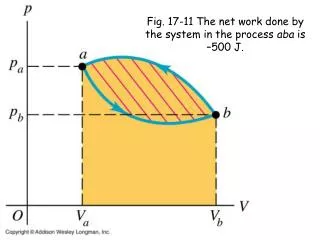
Fig. 17-11 The net work done by the system in the process aba is –500 J.
KINDS OF THERMODYNAMIC PROCESSESADIABATIC – NO HEAT TRANSFER; Q = 0; DU = -WISOCHORIC – CONSTANT VOLUME; DU = Q ISOBARIC – CONSTANT PRESSURE; W = p (V2 – V1)ISOTHERMAL – CONSTANT TEMPERATURE; only for ideal gas DU = 0, Q = W The First Law of Thermodynamics Q = DU + W or DU = Q - W
Fig. 17-13 Processes for an ideal gas:adiabatic Q=0isochoric W=0isothermal DU=0
Fig. 17-14 The internal energy of an ideal gas depends only on its temperature, not on its pressure of volume.
Fig. 17-15 Raising the temperature of an ideal gas by various processes Q = DU + W and DU= f(T)Isochoric W=0 so Q=DUIsobaric Q = DU + p(V2-V1)