Download
1 / 15
150 likes | 269 Vues
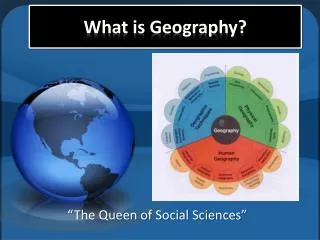
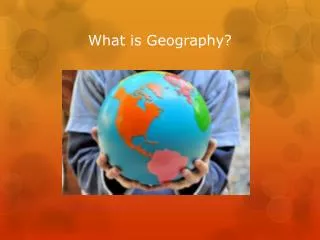
Geography is the study of the Earth, derived from the Latin "geo" meaning Earth and Greek "graphy" meaning map. It involves mapping and understanding patterns and processes related to locations. Geographers explore key questions such as "Where is it located?" and "Why is it significant?" The five themes of geography—location, place, movement, human-environment interaction, and region—help define areas based on their characteristics and interactions. Through this lens, we examine how humanity shapes and is shaped by our environment and geographic contexts.

E N D
What is Geography? Right here. Right Now
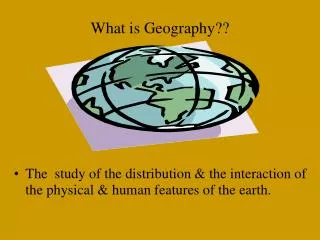
What is Geography? • “Geo” is Latin for Earth. • “Graphy” is Greek for graph or map. • So….Geography is the mapping of the earth, looking for patterns and processes.
Geographers ask….. • Geographic Questions: • Where is it located? • Why is it there? • What is significant about its location? • How is its location related to the location of other people, places, and environments?
Five Themes of Geography • Location • Place • Movement • Human-Environment Interaction • Region
Location • Absolute-A point on the earth's surface expressed by a coordinate system such as latitude and longitude. • Ex. Goose Creek Memorial High School is located at 6001 Wallisville Rd. Baytown, TX • Relative-A location of a place in relation to another place (i.e. south or downhill). • Ex. Goose Creek Memorial is North of I-10 between Garth and North Main in Baytown.
Place • Place-describes the human and physical characteristics of a location. • Physical-mountains, rivers, beaches, plant life. • Human-architecture, religion, transportation, food.
Place Physical Human
Movement • How goods, ideas and people get places and how are the movements associated with the earth affect mankind – wind, weather, water, tectonics, earthquakes, volcanoes…. • Ex. Facebook, fashion…
Human-Environment Interaction • HEI-How humans adapt to and modify the environment. • Humans shape the landscape through their interaction with the land; this has both positive and negative effects on the environment.
Region • Region-Geographers way to categorize specific traits of an area, but is an imaginary boundary • Ex. The South, the Middle East • Regions can be formal, functional, or perceptual.
Region • Formal-limited number of related characteristics (physical and cultural), and have distinct boundaries. • Ex. Latin America, Europe, U.S. • Functional-an organized set of interactions between places. • Ex. The port of Houston, metro bus system • Perceptual-based on what people see and how they categorize themselves. • Ex. The South, The Middle East, the Midwest.