The Scientific Method
The Scientific Method is a systematic process used by scientists to answer questions and solve problems. It consists of six key steps: Problem, Research, Hypothesis, Experiment, Analysis, and Conclusion. Students must learn to follow these steps for a successful controlled investigation. This audio clip, "The Scientific Method (Lyrical Life Science)," emphasizes the importance of logical thinking and verification in scientific inquiry. By breaking down the process, students develop critical skills in scientific reasoning and experimentation.

The Scientific Method
E N D
Presentation Transcript
The Scientific Method 6thScience Mrs. Bright
STANDARD • 6-1.4 • It is essential for students to follow appropriate steps when conducting a controlled scientific investigation.
What is the ScientificMethod? • It is a process that scientists use to solve problems. The Scientific Method (Lyrical Life Science) audio clip
Scientist have to take the time to think logically when they are investigating a question or problem. • They break things down into many steps that make sense.
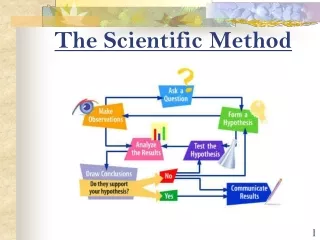
The steps of the Scientific Method are: • 1.Problem • 2.Research • 3.Hypothesis • 4.Experiment • 5.Analysis • 6.Conclusion The Scientific Method (Lyrical Life Science) audio clip
RESEARCH • Gathering information about your topic.
HYPOTHESIS • A possible solution to your problem. • You predict what you think the outcome of your experiment might be. • An IF…Then statement
EXPERIMENT • A plan to test your hypothesis.
EXPERIMENT • Includes a list of materials • Includes step-by-step procedures • Identifies the manipulated (independent) variable that goes on the x-axis. • Identifies the responding (dependent) variable that goes on the Y-axis. • Identifies the controls that remain the same throughout the experiment. • Set up data table to record results.
Once a scientist completes an experiment, they often repeat it to see if they get the same findings and results. • This is really what we call verification, or checking things out to make sure everything was valid and will happen again and again.
ANALYSIS • Carefully observe and document the results of your experiment. • Recorded data in data table and graph. AaHa!! Look at this!!!
CONCLUSION • A statement that sums up what you learned from your experiment. • Was your hypothesis supported or not?