Download
1 / 3
30 likes | 176 Vues
This study showcases an ultra-low voltage operation for a digital baseband processor designed for Ultra-Wideband (UWB) radios, aiming to meet a throughput constraint of 500 MSPS while maintaining a 100 Mbps data rate. Targeting battery-operated devices, the approach emphasizes extreme parallelism to minimize energy consumption significantly. Achievements include a 14x reduction in total energy and a 6x decrease in baseband energy, achieving an unparalleled energy efficiency of 20 pJ/bit for 4-kbit packets. Acknowledgments to DARPA and NSERC Fellowship support for this innovative research.

E N D
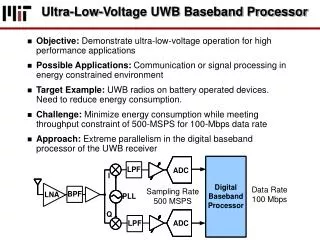
Data Rate 100 Mbps Sampling Rate 500 MSPS Ultra-Low-Voltage UWB Baseband Processor • Objective: Demonstrate ultra-low-voltage operation for high performance applications • Possible Applications: Communication or signal processing in energy constrained environment • Target Example: UWB radios on battery operated devices. Need to reduce energy consumption. • Challenge: Minimize energy consumption while meeting throughput constraint of 500-MSPS for 100-Mbps data rate • Approach: Extreme parallelism in the digital baseband processor of the UWB receiver
Proposed Parallelized Architecture Improve energy-efficiency by exploiting TWO forms of extreme parallelism in the correlator in baseband processor • Ultra-Low-Voltage Operation: Maintain Throughput (20x) • Reduce supply voltage • Minimize energy of baseband processor • Reduce Acquisition Time: Parallelized Computation (31x) • Reduce receiver on-time • Minimize energy of entire receiver 620 correlators
3.3 mm Minimum Energy Point Total Energy Reduce RF front-end and ADC energy! 14X overall reduction Acquisition Energy 3.3 mm Dynamic Energy Leakage Energy Results and Performance Summary ST 90-nm CMOS 281,260 gates 25 MHz @ 0.4 V Reduced baseband energy by 6x Reduced receiver energy by 14x Baseband consumes 2 mW [20 pJ/bit] for a 4-kbit packet Lowest reported energy per bit! Acknowledgments: DARPA and NSERC Fellowship for funding