Download
1 / 9
90 likes | 187 Vues
Learn about Newton’s 3rd Law and how forces interact with each other, leading to equal and opposite reactions. Explore examples and calculations to grasp the concept effectively.

E N D
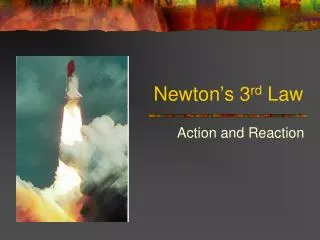
Newton’s 3rd Law Action and Reaction
Force Pairs • A force is always applied by a secondary object • The object to which the force is applied also exerts a force back on the initial object • Whenever there is one force, there is a second force
Newton’s 3rd Law • Whenever one object exerts a force on a second object, the second object exerts an equal and opposite force back on the first • For every action, there is an equal and opposite reaction • The “action” and “reaction” forces act on different objects, this results in a different acceleration for both
Examples of Action and Reaction • A book pushing down on a desk with 10 N • An ice skater pushing against the railing • A rocket engine • Car • Walking
Example 1 • Two carts, one with a mass of 3 kg, and the other with a mass of 1 kg are sitting end to end on a desk. One the “explodes” and exerts a force of 50N on the other, what is the acceleration of each?
Example 2 • Two blocks are attached by a string; block A is on the left and has a mass of 20 kg, block B on the right and has a mass of 10 kg. Block A is pulled with a force of 60 N (W). Find the acceleration of the two blocks and the tension on the string between the two.