Download
1 / 49
490 likes | 626 Vues
The Election of 1800 marked a pivotal moment in U.S. history as Federalists nominated John Adams for president while Republicans chose Thomas Jefferson as his running mate. This election was characterized by intense political rivalry, with rampant accusations, such as Adams being called a monarchist and Jefferson depicted as a radical. The resulting tie led to a prolonged decision in the House of Representatives, culminating in Jefferson's victory. This election not only shifted power but also prompted the passage of the 12th Amendment, changing the electoral process for future elections.

E N D
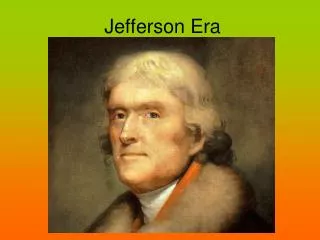
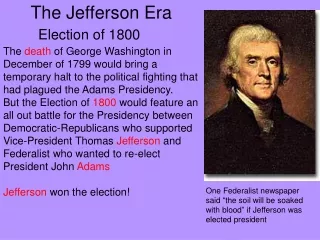
Election of 1800 • Federalists nominate Adams again; Republicans nominate Adams’ VP, Thomas Jefferson • For the first time, political parties really begin attacking each other in their campaigns • Adams is portrayed by Republicans as a monarchist who wants to set himself up as king • Jefferson is portrayed a pro-revolution radical set on destroying the national government
Jefferson and Aaron Burr both receive 73 electoral votes • Adams gets only 65 votes • The tie creates a BIG problem: Who would be President?
House of Representatives votes on who will be the next President • After 36 different votes, Jefferson finally wins the vote and becomes President • Burr becomes VP
Jefferson Wins Out • The House of Rep. is forced to vote to decide the winner • After 36 votes, Jefferson finally wins and becomes the 3rd U.S. president; Burr is VP and NOT happy • Leads to the 12th Amendment which makes separate ballots for the President and VP
Jefferson’s Inauguration • Jefferson was less formal than Washington and Adams • Walked to the new Capitol building to give his first speech; didn’t think the leader of a republic should ride in a fancy carriage • Jefferson was excited about the construction of the new capital city • Free from any state influence
Jefferson in Office • As leader of the new Democratic-Republican party, Jefferson had many things to accomplish • First, he hand-picked his cabinet, including future president James Madison
Jefferson also wanted to limit the role of the national government • Let the Alien & Sedition Acts expire • Cut the size of the American military; would use the extra money to pay off national debt • Searched for ways to get rid of domestic taxes, like the one on whiskey
Once Against, Now For. . . • The National Bank • Although he once fought against it, he was later convinced to leave it alone because it raised a lot of money for the government
F.O.A. (Bellwork) What is happening in this editorial cartoon?
F.O.A. (Bellwork) • Thomas Jefferson literally thought a giant cybernetic John Marshall robot would lay waste to our brand-new Capitol.
EQs • Who were the first five presidents, what years were each of them in office, and what was one major accomplishment for each of the five men? (8.6 spi 1) • What did the cases of Marbury vs. Madison and McCulloch vs. Maryland do for the power of the Supreme Court? (8.6 spi1)
EQs • What are the three main points-of-view an author can use in a story, and why would he or she choose to use each one? (0801.8.2) (CCSS RL6) • How does the reader determine cause and effect when reading a passage? (0801.5.3) (CCSS RL 5)
Today • Today: Turn in projects; Background on Marbury v. Madison; Reader’s Theater • Monday: War of 1812
Little review • Who beat John Adams in the election of 1800? • Why did Adams lose the election of 1800?
First Major Court Case • Marbury v. Madison • Federalists still dominated the Judicial branch • The night before leaving office, Adams created several new federal “judgeships” and appointed Federalists to these new positions • However, because they happened so late, many of them were never properly delivered to Congress in time
What happened next. . . • William Marbury was supposed to receive one of these positions, but Jefferson would not approve Adams’ “midnight judges” • Marbury asked the Supreme Court to help out, which was headed by a Federalist chief justice named John Marshall
Jefferson believed that the Federalist Marshall would agree with Marbury • But he actually ruled that the Supreme Court did not have the authority to change Jefferson’s decision; ruled the “midnight judges” were unconstitutional • Established the Supreme Court’s power of judicial review (can declare laws unconstitutional)
Reader’s Theater • Mr. Ezzell will read this aloud. • Next, you read it and write down any words that give you trouble. • While you’re reading the story, Mr. Ezzell will assign parts by posting names on a sticky note. The narrator’s parts are in italics. • Let’s review the words that give you problems.
Reader’s Theater • Everyone will practice their lines with a partner for two minutes. • Mr. Ezzell will set the timer on the overhead.
Question • What happened in the play?
Assignment • Write two paragraphs in which you tell me the cause and effect of Marbury v. Madison. • A paragraph is 4-5 sentences. • If you need to use your book, the case is on pages 269-270.
By the early 1800s, Spain was growing tired of trying to maintain the large territory of Louisiana
In 1802, Spain secretly traded the land over to France • Napoleon, France’s emperor, wanted to use it to control all of North America • France was at war with Britain; Napoleon had already conquered much of Europe
Before trading LA, Spain once again closed the NOLA port to the U.S. • Jefferson sends James Monroe to buy only the port of New Orleans from France • Napoleon needs money for war, so he sells the whole territory for $15 million
Jefferson wasn’t happy at first • Strict constructionist; Constitution said nothing about buying new lands • Agrees, however, that it is a good thing in the end; doubles the size of America
Lewis & Clark Expedition • Nobody really knew what was in the new Louisiana Territory • Jefferson hires Meriwether Lewis and William Clark to check it out • They are aided by Sacagawea, a female Indian who interprets for them
Lewis & Clark travel almost 8,000 miles during their expedition • Never find the Pacific Ocean though
The Coming of War • Britain & France both began violating America’s neutrality • Began stealing supplies off American trade ships • The British began forcing some American sailors to serve in the British navy (impressment)
The U.S. responds by passing the Embargo Act • Embargo – The banning of trade • The U.S. basically stopped all trade with everyone; didn’t work
The Embargo Act hurt the U.S. more than it helped; trashed it and then passed another embargo against France & Britain • Had the same effect basically; not very good
Assignment • Draw and color the map on page 273. • Don’t do the Spanish territory or Canada. • Label every American territory, as well as the Mississippi River and Lewis and Clark’s return. • Include a key
F.O.A. (Bellwork) • Organizations that help politicians get elected • Case that ended in the Supreme Court establishing judicial review • Winner of the 1800 election • Winner of the 1796 election • First major battle of the American Revolution • Voyage that slaves were brought on to be sold in America • Washington’s decisions like picking his Cabinet members and leaving office voluntarily • Made it illegal for you to criticize the government • Each branch’s ability to keep the other two from gaining too much power • First 10 amendments to the Constitution • Checks and Balances • Middle Passage • John Adams • Political Parties • Bill of Rights • Thomas Jefferson • Marbury v. Madison • Bunker Hill • Precedents • Alien & Sedition Acts
EQs • What were the causes and effects of the War of 1812? (8.5 spi 4) • What were some of the major battles of the War of 1812? (8.5 spi 4)
This week • Today: War of 1812 notes • Tuesday: Timeline over Chapter 8 • Wednesday: Review game • Thursday: Quiz over Chapter 8, Sections 2 and 4, as well as Marbury v. Madison (pages 269-270). • Friday: TBD • Mr. Ezzell will be absent on Thursday and Friday.
Fighting in the West • Indian forces led by Tecumseh, a Shawnee chief, begin attacking Americans in the West • Defeated at the Battle of Tippecanoe by William Henry Harrison • Evidence reveals that Britain had supplied and aided Tecumseh
Many members of Congress wanted war with Britain; nicknamed “War Hawks” • Most New England Federalists did not want war; wanted to seek peace with Britain
New President • In 1808, James Madison becomes the fourth President • Influenced by the War Hawks (led by Henry Clay), Madison convinces Congress to declare war against Britain in 1812
War of 1812 • Americans vs. British & Native Americans • Fighting begins at sea; U.S. wins a lot in the beginning • Many of Britain’s ships were being used to fight France
Soon, however, Britain begins to win • Defeats France; concentrates solely on U.S. • Use blockades on American ports • Win in Canada, NW Territory, and even Washington, D.C.
Major U.S. Victories • Fort McHenry (Baltimore, MD) • Francis Scott Key & “The Star-Spangled Banner” • Battle of New Orleans • American forces led by Andrew Jackson defeat much larger British force • Last major battle of the War of 1812
Effects of the War • The Treaty of Ghent ends the war • Consequences of the war: • Increased patriotism in America • Broke the power of many Indian groups • American manufacturing increased
Homework • Read pages 284-287 and answer 1-3 all parts on page 287.