Download
1 / 17
170 likes | 304 Vues
This study investigates the combined processes of ozonation and nanofiltration for the treatment of drinking water, aiming to mitigate issues associated with individual methods. Ozonation reduces disinfection byproducts (DBPs) formed during chlorination but can generate other harmful compounds. Nanofiltration effectively removes natural organic matter (NOM), yet faces challenges like fouling. Utilizing ceramic membranes resistant to ozone degradation, the experimental results show that this combined approach enhances DBP removal and minimizes membrane fouling, offering an improved solution for water treatment.

E N D
Combined Ozonation-Nanofiltration for Drinking Water TreatmentB.S. Karnik1, K.C. Chen1, D.R. Jaglowski2,S.H. Davies 1,3, M.J. Baumann2, S.J. Masten11Civil & Environmental Engineering2 Chemical Engineering & Materials Science3 Biosystems & Agricultural Engineering Michigan State University
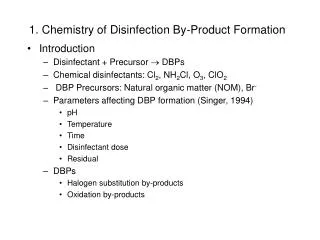
Chlorination Disinfection Byproducts (DBPs) • Disinfection byproducts are formed by the reaction of chlorine with natural organic matter. • The compounds formed include • trihalomethanes (THMs; e.g., chloroform, chlorodibromomethane, bromoform) • haloacetic acid (HAAs) (e.g., dichloroacetic acid) • chloropicrin and dichloroacetonitrile
Technologies for the reduction of DBP formation • Enhanced coagulation • Granular activated carbon • Membrane filtration • Alternate disinfectants • Chlorine dioxide • Chloramines • UV radiation • Ozone
Ozone • Ozonation decreases the formation of chlorinated DBPs • Leads to the formation of other DBPs, including • ketones, aldehydes, bromate • biodegradable organic carbon (BDOC) • In high TOC waters, ozonation • is expensive • leads to excessive DBP formation
Membrane filtration • Nanofiltration can remove >90% of natural organic matter (NOM) • Extent of removal depends upon operational conditions, including molecular weight cutoff and water quality • Problems • low permeate flux • fouling • cleaning of membranes
Combined Ozonation /Nanofiltration • Aim is to combine both processes to reduce problems associated with the use of the processes individually • Ceramic membranes • resistant to degradation by ozone • less subject to NOM fouling than many polymeric membranes • costly compared to polymeric membranes
Experimental details • Membrane • TiO2 filtration layer on an AZT (Aluminum/Zirconium/Titanium Oxide) support • MWCOs 1 kD, 5 kD and 15 kD • pore size ca. 1 nm, 3 nm and 10 nm • Experimental conditions • Cross flow filtration – cross flow velocity 1.5 m/s • Ozone: 1.0 to 12.5 g/m3 @ 100 ml/min • Trans-membrane pressure – 0.21-0.23 bar • Temperature – 20oC • All samples pre-filtered through a 0.45 µm filter
Water source Lake Lansing (Haslett, MI) • borderline eutrophic • algal blooms occur in Summer • hardness - 150 mg/L as CaCO3 • high dissolved organic carbon – 8 to 11 mg/L Potential for membrane fouling is high
Ozone 12.5 g/m3 Refouling after ozonation
TTHM precursor removalEffect of MWCO Filtered raw water – 236 4 g/L O3 - 2.5 g/m3
HAA precursor removal:Effect of MWCO Filtered raw water – 89 5 g/L O3 - 2.5 g/m3
Ozone DBP removal O3 - 2.5 g/m3
Summary – Fouling Studies • Ozonation at low dosages reduces fouling; if ozone dosage is high enough no fouling occurs • The reaction of ozone with foulants appears to be enhanced at the membrane surface, presumably due the catalytic degradation of ozone by TiO2
Summary – DBP studies • The combined process yields better results than for ozone alone • Lower DBP concentrations are obtained with tighter membranes • In the range studied, ozone dosage has little effect on THM or HAA precursor removal • 1 kD MWCO membrane gives good removal for all the DBPs studied; 5 kD gives good removal of chlorinated DBPs