Understanding mRNA Function and Ribosome Mechanics in Protein Synthesis
This article explores the role of mRNA, tRNAs, ribosomes, and the intricate processes of protein synthesis. Key components like open reading frames, codons, and charging of tRNAs by aminoacyl-tRNA synthetases are outlined. We delve into the structure of tRNA, highlighting its acceptor arm, anticodon loop, and unique bases such as pseudouridine and methyluracil. Furthermore, the function of ribosomes in translating mRNA and their presence as polyribosomes is discussed, illustrating the efficiency of protein production in cells.

Understanding mRNA Function and Ribosome Mechanics in Protein Synthesis
E N D
Presentation Transcript
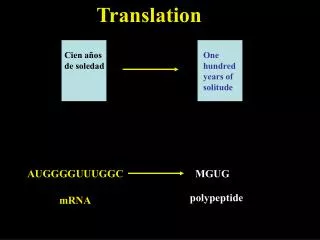
Translation Cien años de soledad One hundred years of solitude AUGGGGUUUGGC MGUG polypeptide mRNA
What’s needed? mRNA tRNAs ribosome
open reading frame mRNA many aa codons cap UAG AUG (A)n size usually 500 - 5000 nt
tRNA acceptor arm about 80 nt contains unusual bases pseudouracil () D loop dihydrouracil (D) loop (T) methyluracil anticodon loop Kenyon College
Essential Biochemistry Wiley Kenyon College Thinkquest
amino acid aa tRNA synthetase charging of tRNAs aminoacyl tRNA carboxyl group of aa connected to 3’ OH of tRNA
arginyl tRNA Arg + tRNA Arg tRNA synthetase specific for one aa and its correct tRNAs specificity of aa tRNA synthetases many amino acids have more than one tRNA
each mRNA may have several ribosomes on it (polyribosome = polysome) rRNAs half of all RNA in the cell # of ribosomes very large ( 106 in a large cell)