Atomic Models
Explore the historical development of atomic models, beginning with Dalton's Billiard Ball Model, which introduced the idea of atoms as neutral solid spheres, the smallest units of matter. We then delve into Thomson's Plum Pudding Model, highlighting the discovery of electrons and a positively charged matrix. Rutherford's Nuclear Model revealed a dense nucleus, while Bohr's Solar System Model defined electron energy levels. Finally, the Quantum Model presents electrons as a cloud surrounding a central nucleus, showcasing the atom's complexity and the evolution of scientific thought on atomic structure.


Atomic Models
E N D
Presentation Transcript
History of atoms Atomic Models
Dalton’s Model (B) Billiard Ball Model • It is a neutral solid sphere. • Smallest unit of matter Neutral (no charge)
JJ. Thomson’s Model (D) Plum Pudding Model • Negatively-charged particles called electrons • Soft positively charged sphere • Overall neutral Electrons – negatively charged particles Positively charged sphere
Rutherford’s Model (A) R Nuclear Model Not a solid sphere but mostly empty space. Nucleus is dense, positively charged, and in the center. Electrons are tiny and negatively charged.
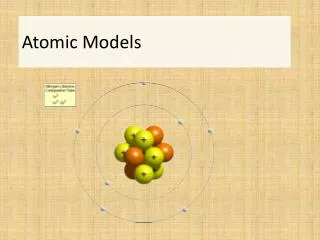
Bohr Model (E) • Solar System Model • Protons (positively charged particles) and neutrons (neutral particles) concentrated in center • Electrons are located at specific distances from nucleus (energy levels).
Quantum Model (C) • Electron Cloud • Nucleus consist of protons (positive charge) and neutrons (neutral). • Electrons are constantly moving in a cloud around the nucleus.