Evolution of Atomic Models: From Dalton to Quantum Mechanics
This overview explores the progression of atomic models from Dalton's solid sphere to the quantum mechanical model. Dalton introduced the ideas of conservation of matter and definite composition, followed by Thomson’s plum pudding model which revealed the electron. Rutherford’s nuclear model highlighted the nucleus and mostly empty space in atoms, while Bohr's model introduced energy levels and orbits. We further delve into quantum mechanics, discussing orbitals, wave-particle duality, and their implications in predicting molecular shapes and chemical behavior.

Evolution of Atomic Models: From Dalton to Quantum Mechanics
E N D
Presentation Transcript
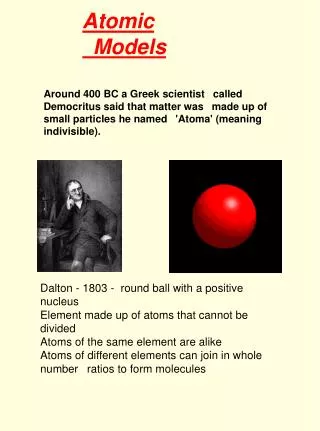
Dalton’s Atomic Model • Solid sphere • Evidence: • Conservation of matter • Law of definite composition • Law of multiple proportions
Thomson Plum Pudding • Based on the discovery of the electron • Evidence • Cathode Ray Experiment • Deflection by magnetic fields and electric fields • Charge to mass ratio of electrons • Big Charge Little mass • Atoms are composed of electrons and something positive +
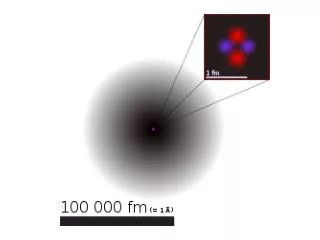
Rutherford • Nuclear Model • Evidence – Gold Foil Experiment • Most Some Few • Mostly Empty Space • Dense Positively Charged Central Portion • Electrons outside the nucleus • Nucleus and Empty Space
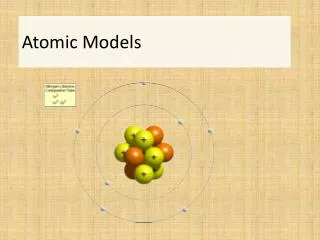
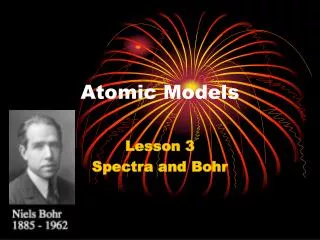
Bohr • Orbits • Energy Levels • Evidence • Flame tests, neon lights, LED, fluorecent • Emission Spectrums • Wave and Particle Properties of Light • Energy transitions absorption and release of light
1s22s2 2px2 2py22pz23s2 • Quantum, Orbitals,Wave Mechanical Model • Flame tests, Neon Lights, LED,fluorescence • Wave and Particle Properties • Orbitals – Energy Levels • Orbital – size, shape orientation • Probability regions of space • Electron Configurations • Predict shapes of molecules • Predict chemical behavior – chemical bonding