Models of Atomic Structure
320 likes | 448 Vues
This overview explores the progression of atomic models from Dalton's solid spheres to the Quantum model. Dalton proposed unbreakable, neutrally charged spheres. Thomson introduced cathode rays, which were identified as negatively charged electrons. Rutherford’s gold foil experiment challenged the Plum Pudding model by revealing a concentrated nucleus, leading to the Rutherford-Bohr model, where electrons orbit the nucleus in defined energy levels. The Quantum model further advanced this understanding by depicting electrons as clouds of probability, emphasizing their dynamic behavior.


Models of Atomic Structure
E N D
Presentation Transcript
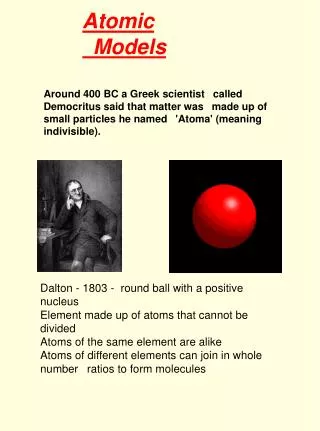
Dalton Model • Unbreakable neutrally charged spheres.
Thomson’s Cathode Ray Experiment • Cathode rays originate from neutrally charged atoms. • Cathode Ray Tube • Cathode rays have a negative charge and are deflected by electrical charges and magnetic fields. • Cathode rays are electrons.
Plum Pudding Model • Negative electrons stuck inside and on the surface of a positive pudding. • Atom’s mass and positive charge is widely spread. • Electrons might wander but mostly motionless unless kicked out by a lot of energy. • Chocolate chips in ice cream.
Plum Pudding Model • Negative electrons stuck inside and on the surface of a positive pudding. • Atom’s mass and positive charge is widely spread. • Electrons might wander but mostly motionless unless kicked out by a lot of energy. • Chocolate chips in ice cream.
Rutherford’s Gold Foil Experiment • Most alpha particles (42He) passed right through the gold foil. • A few alpha particles had very large deflections. • The Plum Pudding model would predict only small deflections. • The mass and positive charge of an atom is concentrated in a very small nucleus.
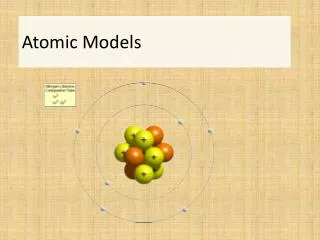
Rutherford-Bohr Model • Electrons orbit in regular “planet-like” energy levels around the positive nucleus. • Nucleus takes up very little space. • Electrons jump up to a higher energy level when they absorb energy. • Electrons falls down to a lower energy level when they emit energy.
Rutherford-Bohr Model • Electrons orbit in regular “planet-like” energy levels around the positive nucleus. • Nucleus takes up very little space. • Electrons jump up to a higher energy level when they absorb energy. • Electrons fall down to a lower energy level when they emit energy.
Quantum Model • Electron cloudsnot orbits. • Electrons are not found in fixed locations, but rather probabilities to be in a location.
Key • Atomic Number • Number of Protons • Number of Electrons(when atom is neutrally charged) • Property unique to each element 11 Na Sodium 22.99
Key 11 Na Sodium 22.99 Average atomic mass* • Weighted Average number of Protons and Neutrons (approximately)
Subatomic Particlesthe particles that make up an atom • Protons – high mass, positive charge. Found in nucleus. • Neutrons – high mass, no charge. Found in nucleus. • Electrons – low mass, negative charge. Found orbiting around nucleus. (abbreviated e– )
Basic Electrical Charge Laws + and– : Attract (pull together) –and– : Repel (push away) + and + : Repel (push away) Like charges repel and Oppositesattract
An Atom Nucleus 1 proton = H = hydrogen
Why doesn’t the electron fall into the nucleus? • It orbits because the electron is moving really fast around the nucleus. • Because the electron has such a low mass, even a small amount of energy makes it move very fast.
An Atom Nucleus 1 proton = H = hydrogen
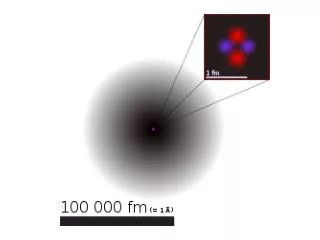
Another Atom Size of atom Size of nucleus 2 protons = He = helium
K H Na Li Mg Ca Be He O S Cl Ar F P N Br Kr C Si Al Ne B I Xe