Download
1 / 2
20 likes | 139 Vues
This week's BLIP operations report indicates a significant increase in the weekly average beam current to 102.5 µA, the highest recorded this year. Operations were adjusted to a total of 120.8 hours due to a temporary decrease in demand for Sr-82, which has since resumed production following an uptick in secondary user demand. Additionally, investigations are ongoing regarding leaks in Ga targets, with the Linac scheduled to optimize octupole beam profile to reduce target power density. Alternative cladding materials are also being explored.

E N D
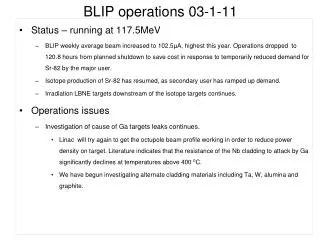
BLIP operations 03-1-11 Status – running at 117.5MeV BLIP weekly average beam increased to 102.5µA, highest this year. Operations dropped to 120.8 hours from planned shutdown to save cost in response to temporarily reduced demand for Sr-82 by the major user. Isotope production of Sr-82 has resumed, as secondary user has ramped up demand. Irradiation LBNE targets downstream of the isotope targets continues. Operations issues Investigation of cause of Ga targets leaks continues. Linac will try again to get the octupole beam profile working in order to reduce power density on target. Literature indicates that the resistance of the Nb cladding to attack by Ga significantly declines at temperatures above 400 0C. We have begun investigating alternate cladding materials including Ta, W, alumina and graphite.