Metric System Basics for Easy Conversions
140 likes | 161 Vues
Learn the fundamentals of the metric system: base units, prefixes, and conversions. Discover how prefixes are based on powers of 10 and how to move the decimal point for conversions. Start converting with ease today!


Metric System Basics for Easy Conversions
E N D
Presentation Transcript
Metric System • The metric system is based on a base unit that corresponds to a certain kind of measurement • Length = meter • Volume = liter • Weight (Mass) = gram • Prefixes plus base units make up the metric system • Example: • Centi + meter = Centimeter • Kilo + liter = Kiloliter
Metric System • The three prefixes that we will use the most are: • kilo • centi • milli
Abbreviations Base Units: • m = meter • l = liter • g = gram Prefixes: • k = kilo • h = hecto • dk = deca/deka • d = deci • c = centi • m = milli
Metric System • These prefixes are based on powers of 10. What does this mean? • From each prefix every “step” is either: • 10 times larger or • 10 times smaller • For example • Centimeters are 10 times larger than millimeters • 1 centimeter = 10 millimeters
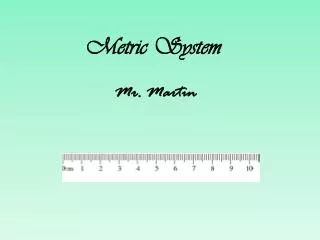
Metric System • Centimeters are 10 times larger than millimeters so it takes more millimeters for the same length 1 centimeter = 10 millimeters Example not to scale 40 41 40 41 1 cm
Metric System • For each “step” to right, you are multiplying by 10 • For example, let’s go from a base unit to centi 1 liter = 10 deciliters = 100 centiliters 2 grams = 20 decigrams = 200 centigrams ( 1 x 10 = 10) = (10 x 10 = 100) (2 x 10 = 20) = (20 x 10 = 200)
Metric System • An easy way to move within the metric system is by moving the decimal point one place for each “step” desired Example: change meters to centimeters 1 meter = 10 decimeters = 100 centimeters or 1.00 meter = 10.0 decimeters = 100. centimeters
Metric System • If you move to the left in the diagram, move the decimal to the left • If you move to the right in the diagram, move the decimal to the right
Metric System • Now let’s start from centimeters and convert to kilometers 400000 centimeters = 4 kilometers 400000 centimeters = 4.00000 kilometers
Metric System • Now let’s start from meters and convert to kilometers 4000 meters = 4 kilometers • Now let’s start from centimeters and convert to meters • 4000 centimeters = 40 meters
Metric System • Now let’s start from meters and convert to centimeters 5 meters = 500 centimeters • Now let’s start from kilometers and convert to meters • .3 kilometers = 300 meters
Metric System • Now let’s start from kilometers and convert to millimeters 4 kilometers = 4000000 millimeters or 4 kilometers = 40 hectometers = 400 decameters = 4000 meters = 40000 decimeters = 400000 centimeters = 4000000 millimeters
Metric System • Summary • Base units in the metric system are meter, liter, gram • Metric system is based on powers of 10 • For conversions within the metric system, each “step” is 1 decimal place to the right or left • Using the diagram below, converting to the right, moves the decimal to the right and vice versa