Analysis of IgD Binding Characteristics in A549 Cells Related to Collagen and Cellular Interaction
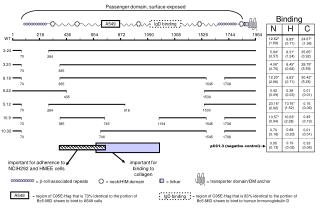
This study explores the binding properties of Immunoglobulin D (IgD) to A549 cells and its implications for adherence and interaction with NCIH292 and HMEE cells. It examines the structural similarities of the binding regions of O35E-Hag and Bc5-MID, which demonstrate a high degree of identity (73%-83%). The findings highlight the importance of specific domains, including the transporter and anchor regions, in facilitating the binding process. This research provides insights into cellular behavior and potential applications in therapeutic contexts.

Analysis of IgD Binding Characteristics in A549 Cells Related to Collagen and Cellular Interaction
E N D
Presentation Transcript
Passenger domain, surface-exposed Binding N H C A549 IgD binding 1 218 436 654 872 1090 1308 1526 1744 1964 WT 12.62* (1.69) 24.67* (1.96) 8.83* (0.71) 2.24 5.94* (0.57) 8.31* (1.24) 35.65* (3.92) 284 3.20 28.79* (5.59) 4.06* (0.75) 8.45* (0.68) 385 70 70 70 70 70 70 20.42* (5.24) 12.20* (2.66) 4.63* (0.71) 8.18 385 1545 1708 284 918 6.22 0.01 (0.01) 0.42 (0.09) 0.38 (0.03) 435 1539 10.76* (1.52) 0.16 (0.06) 23.16* (2.92) 5.12 1539 0.49 (0.19) 13.57* (0.94) 10.63* (2.28) 10.9 385 745 1194 1545 1708 0.88 (0.20) 0.70 (0.16) 0.01 (0.01) 10.32 706 1545 1708 0.19 (0.02) 0.95 (0.13) 0.33 (0.06) pCC1.3 (negative control) important for adherence to NCIH292 and HMEE cells important for binding to collagen = b-roll-associated repeats = linker = transporter domain/OM anchor = neck/HIM domain A549 = region of O35E-Hag that is 73% identical to the portion of Bc5-MID shown to bind to A549 cells = region of O35E-Hag that is 83% identical to the portion of Bc5-MID shown to bind to human Immunoglobulin D IgD binding