Understanding Fair Queueing: Example and Analysis of Packet Transmission Dynamics
This document presents a comprehensive overview of Fair Queueing, illustrating its principles through practical examples. It focuses on the dynamics of packet transmission in a network, highlighting how flows are managed to ensure equitable access to bandwidth. The interaction between active and inactive flows, as well as their transmission behavior, is examined in detail. The example illustrates critical concepts such as flow lengths, round numbers, and arrival patterns, providing insights into the complexities of network management strategies.

Understanding Fair Queueing: Example and Analysis of Packet Transmission Dynamics
E N D
Presentation Transcript
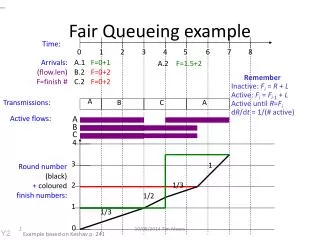
F=1.5+2 A B C A ... ... 1 1/3 1/3 Fair Queueing example Time: 0 1 2 3 4 5 6 7 8 Arrivals: (flow.len) F=finish # A.1 B.2 C.2 F=0+1 F=0+2 F=0+2 A.2 Remember Inactive: Fi = R + L Active: Fi = Fi-1 + L Active until R=Fi dR/dt = 1/(# active) Transmissions: Active flows: A B C 4 3 Round number (black) + colouredfinish numbers: 2 1/2 1 0 10/06/2014 Tim Moors 9751Y2 Example based on Keshav p. 241
A1 ... ... Fair Queueing example 2 Time: 0 1 2 3 4 5 6 7 8 Remember Inactive: Fi = R + L Active: Fi = Fi-1 + L Active until R=Fi dR/dt = 1/(# active) Arrivals: (flowi) F=finish # A1 B1 C1 F=1 F=1 F=1 A2 F=2 B2 F=2 D1 F=15/6 Transmissions: B1 C1 D1 A2 B2 A Because connections (e.g. A&B) remain active until the end of the round, not just until they finish transmitting, packets from previously inactive conn’s (e.g. D1) may be served before others that arrived before them (e.g. A2, B2). B 3 Round number (black) + colouredfinish numbers: 1/2 2 1/3 (52/3,15/6) D inactive 1/4 1 1/3 (31/6,1) C becomes inactive (21/2,5/6) D becomes active 0 10/06/2014 Tim Moors 9751CZ