High Fat Intake Increases Circulating Endotoxin Levels in Type 2 Diabetic Subjects
This study investigates the effect of high saturated fat meals on circulating endotoxin levels in individuals with varying metabolic states, including non-obese, obese, individuals with impaired glucose tolerance (IGT), and type 2 diabetes. Participants consumed a high-fat meal after fasting overnight, with blood samples collected before and after the meal to assess endotoxin levels. Results indicate that high-fat intake elevates circulating endotoxin levels quickly, particularly in IGT and type 2 diabetic subjects, suggesting a link between metabolic endotoxemia and high-fat diets.

High Fat Intake Increases Circulating Endotoxin Levels in Type 2 Diabetic Subjects
E N D
Presentation Transcript
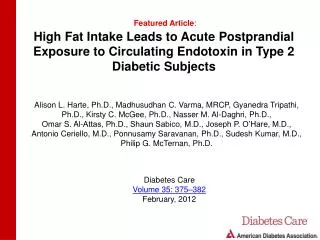
Featured Article: High Fat Intake Leads to Acute Postprandial Exposure to Circulating Endotoxin in Type 2 Diabetic Subjects Alison L. Harte, Ph.D., Madhusudhan C. Varma, MRCP, Gyanedra Tripathi, Ph.D., Kirsty C. McGee, Ph.D., Nasser M. Al-Daghri, Ph.D., Omar S. Al-Attas, Ph.D., Shaun Sabico, M.D., Joseph P. O’Hare, M.D., Antonio Ceriello, M.D., Ponnusamy Saravanan, Ph.D., Sudesh Kumar, M.D., Philip G. McTernan, Ph.D. Diabetes Care Volume 35: 375–382 February, 2012
Study Objectives • To evaluate the changes in circulating endotoxin after a high–saturated fat meal to determine whether these effects depend on metabolic disease state. Harte A et al. Diabetes Care 2012;35:375-382
Study Design • Nonobese, obese, IGT, or type 2 diabetes participants were given a high-fat meal after an overnight fast • Blood was collected before (0 h) and after the meal (1–4 h) for analysis of endotoxin levels Harte A et al. Diabetes Care 2012;35:375-382
Conclusion • Exposure to a high-fat meal elevates circulating endotoxin irrespective of metabolic state, as early as 1 h after a meal. • However, this increase is substantial in IGT and type 2 diabetic subjects, suggesting that metabolic endotoxinemia is exacerbated after high fat intake Harte A et al. Diabetes Care 2012;35:375-382