Download
1 / 10
100 likes | 227 Vues
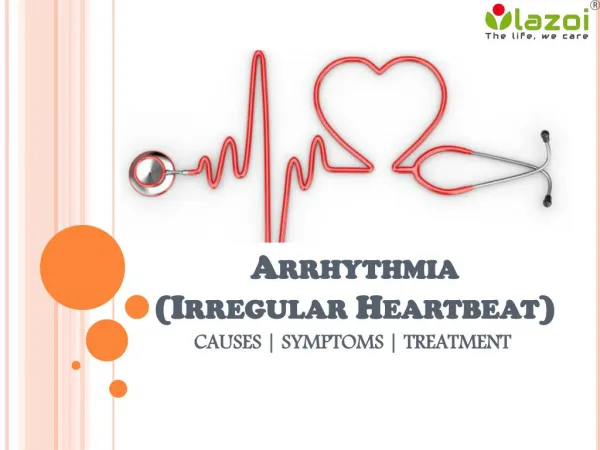
Arrhythmia, derived from the Latin term for "no rhythm," refers to the mistiming of the heartbeat, which can manifest as bradycardia (slow heartbeat), tachycardia (fast heartbeat), or fibrillation (chaotic impulses). Key causes include heart attack, scarring, cardiomyopathy, and genetic factors. Mitochondria play a significant role by affecting ion concentration gradients and electrical signals. Symptoms can range from minor irregularities to serious issues like chest pain and fainting. Treatment options include medications, pacemakers, and surgical procedures.

E N D
What is Arrhythmia? • Latin name: no rhythm • Arrhythmia – mistiming of heartbeat • Types: • Bradycardias – Slow beat • Tachycardias – Fast beat • Fibrilation – Rapid, chaotic impulses
Causes • Heart attack • Heart scarring • Cardiomyopathy – heart muscle damage • Coronary artery disease – clogged heart arteries • Genetic factors
Biological Properties • One cause: hypoxia – low oxygen • Heart beat managed by electrical signals • Signals generated by electrical potential • Potential created by concentration gradient of ions • Hypoxia causes channels to open – depolarization • Disruption of electrical signal disrupts heart beat
Mitochondrial Involvement • sarcKATP channels – maintain potassium ion gradient • Opened by presence of ADP • Failure in mitochondria prevents ATP regeneration, leads to sarcKATP channel opening
Metabolic Properties • Hypoxia causes release of free fatty acids (FFA) • Increases oxygen demand • Hemolysis (rupture) of red blood cells • Detergent effects – breaks lipid membranes • Causes ion concentration gradient to leak
Minor: Unusual heart beat Slow beat Irregular beat Pauses between beats Minor cases – not life-threatening Serious: Low blood supply Dizziness Fainting Short Breath Chest Pains Anemia-like symptoms Symptoms
Heartbeat is controlled by electrical signals; arrhythmia is a disruption to these signals that affect the timing of the heartbeat. Mitochondrial Involvement • Ion concentration gradient within mitochondria • Concentration gradient necessary for electrical signals • Ions gated by channels • Opening of channels – loss of potential • Arrhythmia treated by inhibiting channels
Treatments • Medication • Beta blockers • Channel blockers • Medical Procedure • Pacemaker implant • Surgery • Maze surgery • Cuts, burns in heart to limit path of electric signals
Sources cited • A Metabolic Cause for Arrhythmias During Acute Myocardial Hypoxia • V. A. Kurien, M. F. Oliver. • How Are Arrhythmias Treated?. (n.d.). In National Institute of Health. Retrieved August 15, 2013 • Relationship of Hypoxia to Arrhythmia and Cardiac Conduction Hemorrhage • Richard E. Clark, Ignacio Christlieb, Miguel Sanmarco, Rodriguez Diaz-Perez, J. Francis Dammann, Jr. and Martin E. Zipser • What Are the Signs and Symptoms of an Arrhythmia?. (n.d.). In National Institute of Health. Retrieved August 15, 2013