Mastering Informal Commands in Spanish: A Guide to Tú Instructions
100 likes | 250 Vues
In this lesson, we explore the formation of informal commands (tú) in Spanish. You'll learn how to issue both positive and negative commands, which are essential for everyday conversation. Positive commands use the present tense usted conjugation, while negative commands require a specific conjugation process. We’ll provide examples for both types, including irregular verbs. Practice conjugating common verbs and test your knowledge with interactive exercises. Mastering these commands will help you communicate more effectively and friendly in Spanish!


Mastering Informal Commands in Spanish: A Guide to Tú Instructions
E N D
Presentation Transcript
Informal Commands • To give a command in Spanish, you must first decide whether you wish to use an informal (tú) or formal (usted) command. In this lesson we will focus on informal commands since they are considered to be friendlier. • Secondly, you must be aware of whether you are giving a positive or negative command since each has a different conjugation. For example; Catch (positive) = ¡Agarra! Don’t Catch (negative) = ¡No agarres!
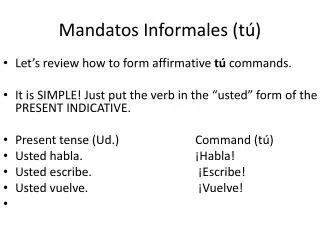
Positive Informal Commands Conjugating a positive informal command is very easy. The conjugation is the same as the present tense usted form of the verb. (Yes, the tú command uses an usted conjugation!) Here are some examples >
Irregulars The following verbs have irregular command forms:
Negative Informal Commands Conjugating a negative informal command is a little more complicated. Here are the steps; • Conjugate the verb in the present tense yo form. • Remove the “o”. • Add “es” to –AR verbs or “as” to –ER & -IR verbs.
Here are some examples; Notice that any stem changes or spelling changes in the yo form remain in the command form.
Irregulars The following verbs have irregular command forms:
Now you try it! On a piece of paper, or in your head, conjugate the following and then click for the correct answer. Note: do not use tú when giving a command. Ask! (Preguntar) Study! (Estudiar) Run! (Correr) Write! (Escribir) ¡Pregunta! ¡Estudia! ¡Corre! ¡Escribe!
Good, now try some negatives! Don’t ask! (Preguntar) Don’t run! (Correr) Don’t return! (Volver o>ue) Don’t come! (Venir) ¡No preguntes! ¡No corras! ¡No vuelvas! ¡No vengas!