Understanding Metals and Non-Metals: Properties, Reactions, and Testing Methods
This guide covers the essential properties and reactions of metals and non-metals. Metals are typically solid, tough, shiny, and excellent conductors of electricity and heat, while non-metals are weak, brittle, and do not conduct these energies. It also discusses reactions of metals with acids, carbonates, and oxide compounds, including how to test for hydrogen and carbon dioxide. The pH scale is explained to identify acids and alkalis, alongside safety symbols and writing chemical equations for various reactions.

Understanding Metals and Non-Metals: Properties, Reactions, and Testing Methods
E N D
Presentation Transcript
Metals Revision Properties and Reactions of Metals
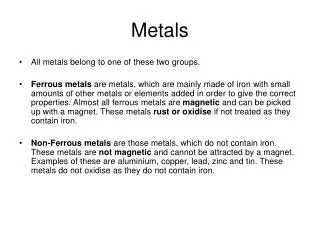
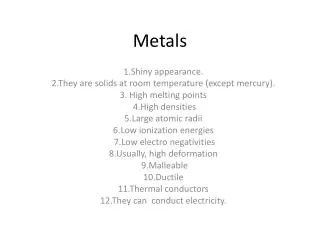
Properties of Metals • Usually Solids • Tough • Shiny • Conduct Electricity • Conduct Heat
Properties of Non Metals • The Opposite! • Solids, Liquids and Gases • Weak and Brittle • Dull • Do Not conduct electricity or heat
Reactions of Metals with Acid METAL + ACID SALT + HYDROGEN Test for Hydrogen? Burns with a squeaky pop!
Acid and Carbonate Rule Acid + Carbonate Salt + Water + Carbon Dioxide Test For Carbon Dioxide? Turns limewater milky
REACTION RULE Acid + Metal Oxide Salt + Water
Equations Copper Oxide + Sulphuric Acid Copper Sulphate + Water CuO + H2SO4 CuSO4 + H2O
Reaction Rule Acid + Alkali Salt + Water
Reaction Equations Potassium + Hydrochloric Potassium + Water Hydroxide Acid Chloride KOH+ HCl KCl + H2O
pH Scale • Using indicator will tell you the pH of the substance you are investigating • Match the colour to the chart • pH of Less than 7 = Acid • pH of Over 7 = Alkali • pH = 7 = Neutral
pH of Less than 7 = AcidpH of Over 7 = AlkalipH = 7 = Neutral
Try Writing Formula Equations Magnesium + Oxygen Magnesium Oxide
Try Writing Formula Equations Sodium + Hydrochloric Sodium + Water Hydroxide Acid Chloride
Try Writing Formula Equations Sulphuric + Copper Copper + Water + Carbon Acid Carbonate Sulphate Dioxide