Enhancing Service Composition with Autonomous Workflow Planning in Grid Environments
10 likes | 139 Vues
This paper explores goal-directed service flow planning and autonomous service composition in grid computing environments. Authors William K. Cheung, Jiming Liu, Maggie M. Wang, Hoi-Fai Wong, and Kevin Tsang address the challenges of resource management by integrating semantic technologies. They present techniques for service discovery and selection, leveraging a bidding mechanism to adaptively choose services that meet user-defined requirements, such as executing specific tasks with desired performance criteria. The research emphasizes improving response times and easing resource management in distributed systems.


Enhancing Service Composition with Autonomous Workflow Planning in Grid Environments
E N D
Presentation Transcript
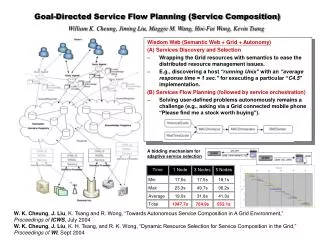
Time 1 Node 3 Nodes 5 Nodes Min 17.6s 17.5s 18.1s Max 23.3s 49.7s 96.2s Average 19.0s 31.8s 41.3s Total 1047.7s 704.9s 552.1s Goal-Directed Service Flow Planning (Service Composition) William K. Cheung, Jiming Liu, Maggie M. Wang, Hoi-Fai Wong, Kevin Tsang • Wisdom Web (Semantic Web + Grid + Autonomy) • (A) Services Discovery and Selection • Wrapping the Grid resources with semantics to ease the distributed resource management issues. • E.g., discovering a host “running Unix” with an “average response time = 1 sec.” for executing a particular “C4.5” implementation. • (B) Services Flow Planning (followed by service orchestration) • Solving user-defined problems autonomously remains a challenge (e.g., asking via a Grid connected mobile phone “Please find me a stock worth buying”). A bidding mechanism for adaptive service selection W. K. Cheung, J. Liu, K. Tsang and R. Wong, “Towards Autonomous Service Composition in A Grid Environment,” Proceedingsof ICWS, July 2004 W. K. Cheung, J. Liu, K. H. Tsang, and R. K. Wong, “Dynamic Resource Selection for Service Composition in the Grid,” Proceedings of WI, Sept 2004