
SlideServe
Menu
Préférences
© SlideServe · v2026

The Legacy of the Prophet's Family: Understanding Legal Codes and Cultural Myths in Islamic History

kelli avatar
8 diapositives · 259 Views · Sep 15, 2014

This exploration delves into the intricate relationship between the family of the Prophet Muhammad and legal codes specific to the Hashimids and Alids. It examines cultural practices, myths surrounding Sayyids, and the complex beliefs affecting the distinctions between Fatima's descendants and Sayyids today. Through a lens of love and animosity towards the Alid lineage, we investigate their theological and legal implications, the role of the Imams, and various sects' perspectives on Ali's legacy. This analysis highlights the enduring influence of the Prophet's family on Islamic thought and identity.
The Legacy of the Prophet's Family: Understanding Legal Codes and Cultural Myths in Islamic History - slide 1
01 / 8The Legacy of the Prophet's Family: Understanding Legal Codes and Cultural Myths in Islamic History
1 / 17

Télécharger la présentation

The Legacy of the Prophet's Family: Understanding Legal Codes and Cultural Myths in Islamic History
Une image / un lien ci-dessous est fourni (tel quel) pour télécharger la présentation

Politique de téléchargement : le contenu du site vous est fourni TEL QUEL pour votre information et votre usage personnel ; il ne peut être vendu, concédé sous licence ni partagé sur d’autres sites sans l’accord de son auteur.Le contenu vous est fourni TEL QUEL, pour votre information et votre usage personnel uniquement. Téléchargez la présentation en cliquant sur ce lien. Lors du téléchargement, si vous ne parvenez pas à télécharger une présentation, l’éditeur a peut-être supprimé le fichier de son serveur.Pendant le téléchargement, si vous ne parvenez pas à obtenir une présentation, le fichier a peut-être été supprimé par l’éditeur.

F I N

Plus de contenu associé

Transcription de la présentation
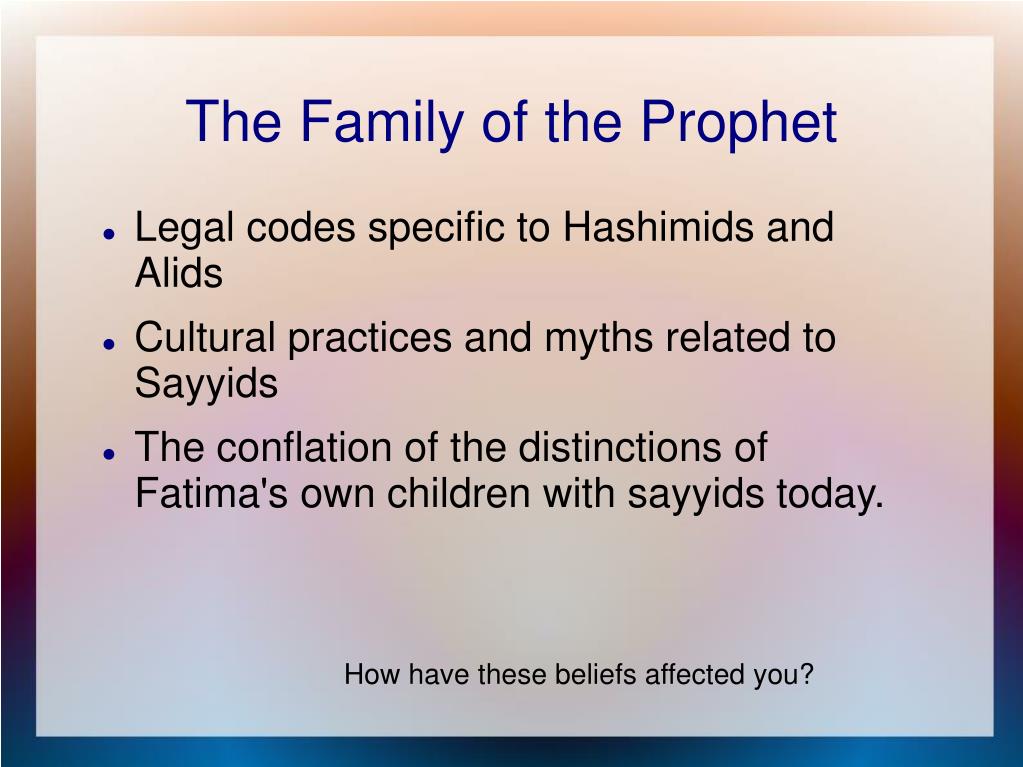
  1. The Family of the Prophet • Legal codes specific to Hashimids and Alids • Cultural practices and myths related to Sayyids • The conflation of the distinctions of Fatima's own children with sayyids today. How have these beliefs affected you?

  2. The Spectrum of Love and Hate Group 1 [the anti-Alid] possessed animosity for Ali and his household. Group 2 opposed granting any special distinction or reverence to Ali. Group 3 opposed the tafḍīl of ‘Alī, but ranked him as the greatest Companion after the previous caliphs. Group 4 believed in the tafḍīl of ‘Alī, but opposed Imāmī veneration of Ali. Group 5 saw him as the divinely selected, sole inheritor of the Prophet, but rejected his deification.

  3. Memories of the Imams • Sunni rapprochement with the Alid heritage. Ahmad b. Hanbal and the four-caliph theory. • The pledge of allegiance, fiscal agents and transactions, sustained tutelage. • Ja‘far al-Ṣādiq and his son ‘Alī b. Ja‘far.

  4. The Twelver Imams • Ali, Hasan and Husayn • (4) Zayn al-‘Ābidīn – The Psalms of Islam & Conversing with God. The Treatise on Rights. • (5) Muhammad al-Bāqir – The articulation of legal codes (see the work of Arzina Lalani). • (6) Ja‘far al-Ṣādiq – Legal theory and theology. • (7) Mūsa al-Kāẓim – The legitimacy of the legatee, financial administration of an insular community • (8) Ali al-Riḍā –Dialectical debates with pro-Alids: Naṣṣ vs. Tafḍīl, spiritual training vs. political allegiance • (9) Muhammad al-Taqī al-Jawād – Dialectical debates with proto-Sunnī interlocutors.

  5. The Twelver Imams • (10) Ali al-Naqī al-Hādī – The method of sending salutations upon prophets and saints. The articulation of the spiritual rank of his forefathers in contrast to Ghulāt, Sunnī ḥadīth, and Zaydī circles. [Ziyārat al-Jāmi‘ah] • (11) Hasan al-‘Askarī – Imāmī law and identity in contrast to antinomian circles [e.g. the Nuṣayrī]. • (12) The Mahdī – Establishing the kingdom of God and justice on earth.

  6. The Zaydī Imams • Ali, Hasan and Husayn • Zayd b. ‘Alī (d.120 AH) • 'Abdullah b. Mu'awiya al-Ja‘farī (r.127 in Kufa) forced to flee to Iran, died 2 yrs later • Nafs al-Zakiyya (d. 145) • Husayn Sahib al-Fakh (169) • Yahya al-Daylami 176/792 • Idris b. Abdallah Imam in N. Africa by 173. Poisoned (175) • Muhammad b. Ibrahim Tabataba d.199/814 • Imam Qasim b. Ibrahim b. Ismail b. Ibrahim al-Rassi (169-246) • Hasan b. Zayd al-Hasanī • Muhammad b. Zayd al-Da'i succeeded him and ruled until 287.

  7. The Zaydī Imams • Imam Hadi ila al-Haqq (245-297) • Imam Nāṣir al-Utrush (r.d 301-304) • al-Mansur billah al-Qasim b. ‘Alī al-‘Iyānī. He came to Yemen in 389/999 and died in 393/1003. His two Grandsons ruled Yemen as well, Qasim died 468/1075 and Dhuʼl Sharifayn Muhammad (d.477/1085). • Muhammad b. Hasan b. Qasim al-Da'i, al-Mahdi li Din Allah (d. 360). • Imam al-Muʼayyad (d.411) • Imam Nāṭiq (d.424) • Imam Mansur (d. 614) • Imam Ahmad b. Yahya al-Murtada (d. 840)

  8. The Household & the piety in protest • The Story of Husayn and Yazid • The caliphate of Hasan b. ‘Alī and his surrender. • The caliphate of Ali • Fatima's legal disputes after the death of the Prophet • Notions regarding spiritual, legislative and executive authority and Ghadīr al-Khumm. Historic Objectives of the Household • Safeguarding the fundamental existence of the religion • Safeguarding the line of Fatima • Ensuring peace and security for their disciples • Inculcating ethical perfection in the community as well as propagating their views on scripture, theology and law. • Ending injustice, oppression and ignorance across the globe.