Download
1 / 25
250 likes | 352 Vues
Explore the components of blood, pathways through the body and heart, and control of heart rate. Learn about the roles of blood vessels, red and white blood cells, and platelets. Understand the structure and function of arteries, veins, and capillaries in blood circulation. Discover the vital functions of the heart in maintaining homeostasis and fighting diseases.

E N D
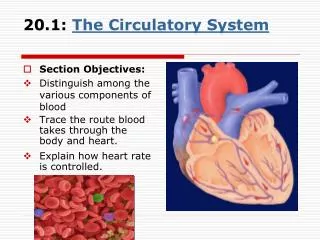
20.1:The Circulatory System • Section Objectives: • Distinguish among the various components of blood • Trace the route blood takes through the body and heart. • Explain how heart rate is controlled.
Circulatory system • made up of 3 parts • organ • heart • tissues & cells • blood vessels • arteries • veins • capillaries • blood • red blood cells • plasma
Your Blood: Fluid Transport • Blood is a tissue of fluid & cells • transports O2 and nutrients to cells • takes away CO2 and other wastes • Aids in fighting disease • Helps maintain body temp. Blood composition: Plasma: 55% (liquid part) Blood cells: 45% (red, white, & platelets
Blood Cell production ribs, vertebrae, breastbone & pelvis • Stem cells • “parent” cells in bone marrow • differentiate into many different types of cells white blood cells white bloodcells red bloodcells
Red blood cells: Oxygen carriers • Bioconcave disc shaped, most numerous • No nucleus when mature, last 120 days • 5-6 million RBC in drop of human blood • Produced in red marrow of long bones • contain hemoglobin • Hemoglobin enables the transport of O2
Hemoglobin • Protein which carries O2 • 250,000 hemoglobins in 1 red blood cell O2 O2 O2 O2
White blood cells: Infection fighters • Largest blood cell • play a major role in protecting your body from foreign substances. White Blood Cells
Platelets: Blood clotting • Smallest (fragments) • help blood clot after an injury. • Short-lived
Blood vessels arteries veins artery arterioles venules arterioles capillaries venules veins
Arteries: Built for their job • Arteries • blood flows away from heart • thicker walls • provide strength for high pressure pumping of blood • elastic & stretchable • maintains blood pressure even when heart relaxes
Major arteries aorta carotid= to head to brain & left arm to right arm to body pulmonaryartery pulmonaryartery=to lungs coronary arteries
Veins: Built for their job Blood flows toward heart • Veins • blood returns back to heart • thinner-walled • blood travels back to heart at low speed & pressure • why low pressure? • far from heart • blood flows because muscles contract when we move • squeeze blood through veins • valves in large veins • in larger veins one-way valves allow blood to flow only toward heart Openvalve Closed valve
Major Veins superiorvena cava= from upper body pulmonaryvein= from lung pulmonaryvein = from lung inferiorvena cava= from lower body
Structure-function relationship • Capillaries • very thin walls • allows diffusion of materials across capillary • O2, CO2, H2O, food, waste body cell waste CO2 O2 food
Your Heart: The Vital Pump • Atria: upper chamber which receive blood that pump blood to • Ventricles: muscular walled chambers which pump blood from heart leftatrium rightatrium leftventricle rightventricle
Circulation of Blood Circulationto lungs • 2 part system • Circulation to lungs • blood gets O2 from lungs • drops off CO2 to lungs • brings O2-rich blood from lungs to heart • Circulation to body • pumps O2-rich blood to body • picks up nutrients from digestive system • collects CO2 & cell wastes lungs heart body Circulationto body
Blood’s path through the heart • 1. vena cavae • 2. right atrium • 3. valve • 4. right ventricle • 5. valve • 6. pulmonary artery (to lungs) • 7. pulmonary veins • 8. left atrium • 9. valve • 10. left ventricle • 11. valve • 12. aortalargest blood vessel in the body.
Heartbeat regulation • surge of blood through an artery is called a pulse. • Pacemaker: initiates heartbeat generates an electrical impulse that spreads over both atria. Sinoatrial node (Pacemaker
Blood pressure • the force that the blood exerts on the blood vessels. • Blood pressure is measured as systolic (ventricles contract) and diastolic (ventricles relax) pressures
Control of the heart • A portion of the brain called the medulla oblongata regulates the rate of the pacemaker, speeding or slowing its nerve impulses. • If the heart beats too fast, the medulla oblongata, sends signals that slow the pacemaker. • If the heart slows down the medulla oblongata sends signals to speed up the pacemaker and increase the heart rate. Medulla oblongata
ATP CO2 O2 Circulatory System & Homeostasis • Homeostasis • keeping the internal environment of the body balanced • need to balance food & O2 in • need to balance energy (ATP) production • need to balance CO2 & waste out • Exercise • heart beat faster • need more ATP • bring in more O2 & food; remove more CO2 & waste out • Disease • poor lung or heart function = heart beat faster • need to work harder to bring in O2 & food & remove wastes food waste
Cardiovascular disease • Atherosclerosis & Arteriosclerosis • deposits inside arteries (plaques) • develop in inner wall of the arteries, narrowing their channel • increase blood pressure • increase risk of heart attack, stroke, kidney damage normal artery hardening of arteries
Cardiovascular health bypass surgery • Risk Factors • genetics • diet • high animal fat • exercise & lifestyle • smoking • lack of exercise
Women & Heart Disease Death rates for heart disease per 100,000 women, 2002 • Heart disease is 3rd leading cause of death among women aged 25–44 years & 2nd leading cause of death among women aged 45–64 years. Risk factors • Smoking • Lack of exercise • High fat diet • Overweight