Identifying Minerals
Dive into the fascinating world of minerals! Explore essential properties like hardness measured by Moh’s scale, luster types such as metallic, glassy, and pearly, and texture descriptions like smooth and rough. Understand how cleavage and fracture affect mineral breaks, and learn about density and specific gravity. Discover the valuable uses of minerals, from ores like hematite to stunning gems such as rubies. Create fun bumper stickers celebrating your love for rocks, like "You Rock—Moh’s Says You’re a 10!" and "I Dig Rocks—Check Out My Luster!"
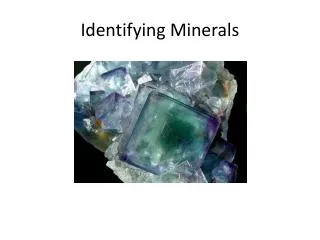

Identifying Minerals
E N D
Presentation Transcript
Pick your favorite mineral property • Make a bumper sticker saying ie: You Rock—Moh Gives You A 10
Color • caused by the presence of other trace elements.
Luster • The way a mineral reflects light • Metallic • Glassy • Adamantine • Silky • Pearly • Pitchy • Waxy • Dull
Texture • Describes how a mineral feels to touch Smooth Rough Ragged Greasy Soapy
Streak • Color of a mineral when it is broken up and powdered.
Hardness • Measures how easily a mineral can be scratched. • “Moh’sHardness Scale”
Cleavage and Fracture • Atomic structure determines how a mineral will break. • Minerals break along weak atomic bonds. • Cleavage occurs if a mineral breaks along a plane (flat surface)
Cleavage and Fracture • Fracture occurs when minerals break with rough or jagged edges. • Conchoidal fracture results in a circular pattern.
Density and Specific Gravity Density = Mass/Volume Specific Gravity • Ratio of weight of a substance to the weight of an equal volume of water at 4°C.
Mineral uses Ores • Contain a useful substance that can be mined. Ex: hematite mined for Fe, Bauxite for Al
Mineral uses Gems • Minerals that are prized for their rarity and beauty. • Rubies and Emeralds are more valuable than diamonds. • YouTube - The Diamond process from the Mine to the Market
Bumper Sticker • I Dig Rocks…Check Out My Lustre • You Rock—Moh says you are a 10