Download
1 / 8
90 likes | 223 Vues
Minerals can be identified by examining their physical properties, which include color, luster, streak, cleavage or fracture, and hardness. While color can vary due to impurities, it is not the most reliable identification method. Luster describes how a surface reflects light, with categories like metallic and nonmetallic. Streak refers to the color of a mineral in powdered form, providing more accurate identification. Cleavage indicates the tendency to break along flat surfaces, whereas fracture describes irregular breakage. Hardness measures resistance to scratching, rated from 1 (softest) to 10 (hardest).

E N D
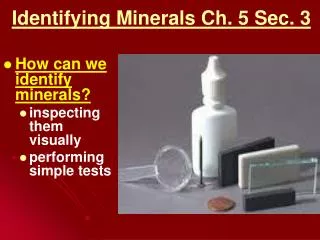
Minerals can be identified by looking at their physical properties including: color, luster, streak, cleavage or fracture, and hardness
Color • Minerals can come in a variety of colors • Colors can be influenced by impurities • Not the best way to identify minerals
Luster • The way a surface reflects light • Minerals can have metallic luster, shiny • Minerals can have nonmetallic luster, dull
Streak • Color of a mineral in powdered form • Less impurities so it is a better way to identify a mineral
Cleavage and Fracture • Cleavage – Tendency to break along smooth, flat surfaces • Fracture – Tendency to break along unevenly curved or irregular surfaces
Hardness • Resistance to being scratched • Minerals are rated 1 to 10 • 10 is the hardest and 1 is the softest