Oncolytic Virotherapy: Mechanisms of Action and Cancer Treatment Insights
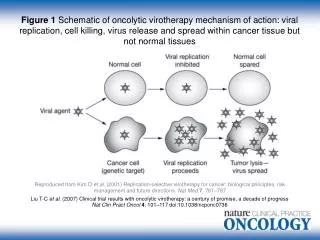
This figure illustrates the mechanism of oncolytic virotherapy, emphasizing its unique ability to selectively replicate in cancer cells while sparing normal tissues. Key processes include viral replication, targeted cell killing, and subsequent virus release and spread within the tumor microenvironment. The foundational research by Kirn et al. (2001) lays out the biological principles and risk management strategies associated with this innovative cancer treatment. Subsequent clinical trial results by Liu et al. (2007) highlight a decade of advancements in unlocking the potential of oncolytic virotherapy for cancer care.

Oncolytic Virotherapy: Mechanisms of Action and Cancer Treatment Insights
E N D
Presentation Transcript
Figure 1 Schematic of oncolytic virotherapy mechanism of action: viral replication, cell killing, virus release and spread within cancer tissue but not normal tissues Reproduced from Kirn D et al. (2001) Replication-selective virotherapy for cancer: biological principles, risk management and future directions. Nat Med7: 781–787 Liu T-C et al. (2007) Clinical trial results with oncolytic virotherapy: a century of promise, a decade of progress Nat Clin Pract Oncol 4: 101–117 doi:10.1038/ncponc0736