Mastering Quotation and Attribution in Writing
Effective writing requires proper use of quotations and attribution to convey clarity and accuracy. Placing commas and periods correctly within quotation marks is vital for grammatical integrity. This guide highlights essential rules, such as where to position attributive phrases, managing multiple sentences in quotes, and ensuring accurate citation of sources. Furthermore, it emphasizes the importance of trimming unnecessary quotes to enhance storytelling and maintaining clear attribution to avoid confusion. Master these skills to improve your writing's professionalism!

Mastering Quotation and Attribution in Writing
E N D
Presentation Transcript
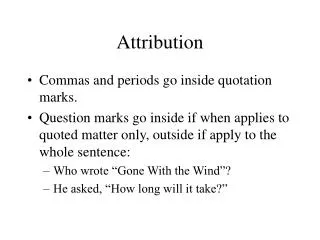
Attribution • Commas and periods go inside quotation marks. • Question marks go inside if when applies to quoted matter only, outside if apply to the whole sentence: • Who wrote “Gone With the Wind”? • He asked, “How long will it take?”
Attribution • Use commas with attribution when you have direct quotes: • “I like being here,” he said. • While grammatically correct, avoid putting attribution at start of direct quote: He said, “I like being here.” Instead, “I like being here,” he said.
Attribution • Use commas with attribution like “according to” • According to school officials, attendance is down. • Attendance is down, according to school officials.
Attribution • Use commas when attributions come after, not before, a paraphrase: • Jackson said the Badgers look strong. • The Badgers look strong, Jackson said.
Attribution • With multiple-sentence quotes, put the attribution after the first sentence: • “I like our chances,” the coach said. “We can will all our games.” • Not: “I like our chances. We can win all our games,” the coach said.
Attribution • The basics: • A period follows the attribution: • “I like you,” he said. “Do you like me?” • A comma almost always proceeds the attribution: • Don’t use an exclamation point and a comma: • Wrong: “Oh boy!,” the child said.
Attribution • Copy editors need to pay close attention to quotes. They are a key area to look at when you need to trim: • Does the quote add to the story? • Does it repeat something already said? • Could you paraphrase the direct quote to shorten it? • See Taking Roll
Attribution • Double-check attribution: • Do you have the right person attributed? • Is the attribution clear? • Is it needed?