Download
1 / 11
110 likes | 239 Vues
This section highlights four vital signs of quality in childcare programs, focusing on the qualifications of directors and staff, licensing and accreditation standards, the adequacy of equipment and activities, and effective communication with parents. Parents are encouraged to learn about staff qualifications, address turnover rates, and verify safety protocols. Additionally, the document outlines licensing requirements mandated by state authorities and the importance of accreditation through organizations like NAEYC. Effective communication between teachers and parents is crucial for building trust and ensuring transparency regarding daily activities and important updates.

E N D
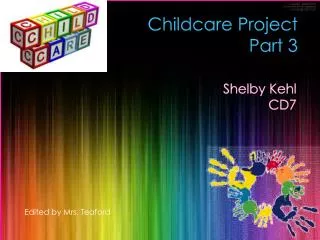
Childcare ProjectPart 3 Shelby Kehl CD7 Edited by Mrs. Teaford
Four Signs of Quality Areas • Directors and Staff Qualifications • Licensing and Accreditations • Equipment and Activities or Program • Communication withParents
Quality Characteristicsof Directors and Staff • Parents should learn as much as possible about the staff member • Should talk about the turnover rate • Make sure there is safety • Give personal attention • Needs to make sure there is at least two adults in case of emergency
License Child Care Programs • The state Human Services • Public Health Department
Difference Child Care Licenses • The licenses are by the State Human Services or Public Health Department. • Must meet minimum requirements • Ex. It must have a certain amount of space for each child
Difference Accreditation • Is by the National Association for the education of the National Association for the education of Young Children (NAEYC) • Program must meethigher standards • Keystone Stars is PA’saccreditation program
Childcare Program’s Equipment • Plenty of carefully chosen toys • Large equipment should be well placed • Should have enough room for the children and the toys. • Don’t want the children to hurt themselves
Childcare Program’s Activities • Well-planned • Age-appropriate • Well-supervised • A balance of large group, small group and playing alone • Caregivers relaxed but involved with children; patient while teaching children new skills
Childcare program’s communication with parents • Need to build trust & cooperation • Teacher to Parent communication • Share what happened each day during pick up time • Signs and information on illness outbreaks • Information on center hours and events • Newsletters and notes home
Childcare program’s communication with parents • Parent to Teacher communication • Conferences • Send notes • Phone calls
Works Cited Hildebrand, Verna. Parenting Rewards & Responsibilites. New York: Glenco McGraw-Hill, 2000. Print