Dynamics of Ion Instability and Tune Shift in Particle Accelerators
This study examines the intricate dynamics of ion instability and tune shifts in particle accelerators, emphasizing the effects of CO+ and H+ ions. It highlights variations in growth rates based on machine design, such as different accelerator types (DAS, TESLA, etc.), bunch spacing, and vacuum conditions. The findings indicate that CO+ induces significant tune shifts compared to H+, revealing the necessity for feedback mechanisms and defining optimal gap lengths to stabilize ion behavior. Understanding these factors is crucial for improving accelerator performance and efficiency.

Dynamics of Ion Instability and Tune Shift in Particle Accelerators
E N D
Presentation Transcript
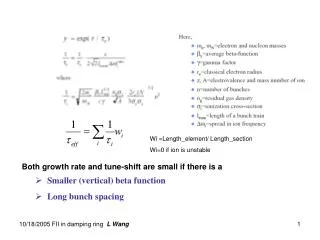
Wi =Length_element/ Length_section Wi=0 if ion is unstable Both growth rate and tune-shift are small if there is a • Smaller (vertical) beta function • Long bunch spacing
Peak growth rate of FII for CO+ Pwiggler=2.0nTorr; Plong_straight=0.1nTorr P_arc=0.5nTorr Growth time is less than 1 turn! Peak growth rate of FII for H+ The growth time is 100 times longer than CO+!! (H+ has small cross section and it is likely unstable after several damping time) 17km ring has a longer growth time Shorter average growth time • TESLA; DAS; MCH; OTW; OCS; BRU;PPA
Tune-shift H+ CO+ The Tune shift caused by CO+ is 30~100 times larger than H+!!
Ion yield Aluminium Copper H+ is dominant component!
Incoherent vertical tune shift-strongly optics dependent Larger tune shift • OTW; DAS; TESLA; MCH; PPA; BRU; OCS • OCS has the longest ARC • OTW has the shortest ARC and small beta at ARC! • DAS, MCH and TESLA has a long bunch spacing!! (ion is Not easy to be trapped)
ATF Nbunch=20, P=10nTorr, 20% is CO+ Radiation damping time 30ms Close to the experiment Tune shift is very small
PLS • Ions are not trapped at some location with the equilibrium emittance, especially in Wiggler • Long straight section PLS(P=5nTorr) • Energy 2.0GeV • Lsep=2ns • x=12.1nm • y=0.12nm • N=1.1681010 • Nbunch=180 • rad=16ms ILC P=5nTorr • Energy 5.0GeV • Lsep=4~20ns • x=0.5nm • y=0.002nm • N=21010 • Nbunch=2820 >100s scaling>21s Calculation (don’t know the optics) 0.9 ms for 100% CO+ 5ms for 100% H+
B-factories KEKB(P=1nTorr) • Energy 8.0GeV • Lsep=2.4m • x=24nm • y=0.4nm • N=5.61010 • Nbunch=1389 • feedback=0.5ms PEPII(P=1nTorr) • Energy 8.0GeV • Lsep=1.26m • x=50nm • y=1nm • N=4.61010 • Nbunch=1732 • cal=0.23ms • Qcal=0.008 scaling_ILC>1s There is no FII observed in usual operation of B-factories except at the beginning of the operation after long shutdown (suppressed by Feedback?) ILC has a faster FII than B-factories
Gaps T Stable Zone with gap (linear model) tgap • Long term motion of ions are likely unstable; (multi-turn trapping is difficult) Trapping time(0.1MHz for 6km ring)
Decay of ion-cloud during the train-gap The decay time of ion-cloud is about 1 times of the ion oscillation period: Wiggler section need a short gap Light ion need a short gap. Gap in KEKB HER: 69.38m(230ns) Gap in PEPII HER: 40m(130ns) (Tco+=110ns; TH+=30ns)
Co+ oscillation period TESLA OCS Damping ring is different from B-factories & Light source The required gap varies with time!
Gap effect on stable zone (OCS) Gap=8 bunch spacing=49.2ns Trapping location varies with time
Summary • The instability/tune shift is dominated by CO+ if it is more than 10% in the vacuum • 17km rings has longer growth time (factor 5~10 better than 6km and 3km rings) • Scaling with the present machines is NOT easy! The shorter growth time is around 100 s (scale with PLS) • Feedback is certainly necessary • Necessary gap is around 1.2 times of ion oscillation period (PEPII). It varies with the time (emittance) and Optics. We need to define the necessary gap for a certain time.
Conclusion • Both DAS and TESLA have longer growth time and small tune shift • Feedback is necessary • Necessary gap is about 1 period of ion oscillation period. 17km ring need a longer train gap Peak growth rate of FII and tune shift with CO+