Biodiversity
Biodiversity. What is biodiversity?. Biodiversity is short for biological diversity and can be defined as the variety of all life forms on Earth… the different plants, animals and micro-organisms, and the ecosystems of which they are a part. What are the three levels of biodiversity?.


Biodiversity
E N D
Presentation Transcript
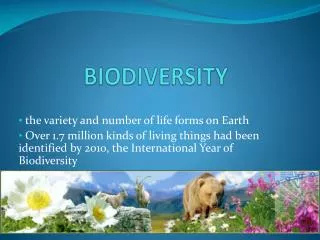
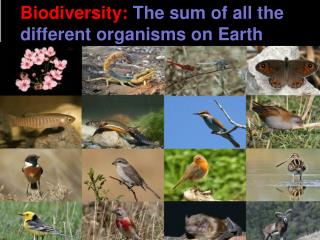
What is biodiversity? • Biodiversity is short for biological diversity and can be defined as the variety of all life forms on Earth… the different plants, animals and micro-organisms, and the ecosystems of which they are a part
What are the three levels of biodiversity? • Genetic diversity: the total genetic information (inheritable characteristics) contained in the genes of all species • Species diversity: the variety and number of speciesthat appear in a particular location or region • Ecosystem diversity: the variety of habitats, natural environments or biological communities in a given region
Why is biodiversity important for planet? • Diversity of plant life regulates the greenhouse effect and the amount of oxygen and carbon dioxide in the atmosphere • Agricultural production is dependent on different species of insect and birds that pollinate numerous crops we eat as food • Stability of ecosystems around the world require a diversity of species to maintain their richness
How is biodiversity lost? • Destruction of an ecosystem directly eliminates the various species of plants and animals that lived there, and the disappearance of one species has an effect on all those around it. • Introduction of a new species of plant or animal into an area can pose a serious threat to other species in the area because the new species might attack or outcompete the original species
What is deforestation? • Deforestation is the clearing of the Earth’s forests on a massive scale, often resulting in damage to the quality of the land
How much forest have we lost? • Deforestation varies around the globe, with the developing world seeing huge expanses of forest cleared every year • Africa is experiencing deforestation at twice the global rate • Brazil has the highest amount of forest removed each year • Canada has less than 0.5 percent of world’s deforestation
What is the link to cultural diversity? • As more and more countries expand into forested areas, the Aboriginal peoples who live in these forests have come under threat • Expansion into these areas reduces living space and their resource base; exposure to the outside world erodes their lifestyles and cultures • As different aboriginal groups are exterminated, a country loses its cultural diversity (i.e. Brazil)
What are three global consequences? • As mentioned above, one of the consequences of deforestation is a loss of cultural diversity • Deforestation also upsets the delicate ecological balance that exists in any given ecosystem • Deforestation increases global warming through removal of massive carbon sinks and through the process of deforestation (burning) itself
What is desertification? • Desertification is the process by which a productive dryland area is degraded to the point that it becomes unproductive desert land
How much of the world is desert? • Desertification threatens close to 900 million people, and that number is expected to rise to over 1.2 billion • More than 100 countries and every continent in the world is affected by desertification • Nearly 3.5 billion hectares of the world’s pasture lands, croplands and irrigated land are at risk of desertification
What events lead to desertification? • There are a number of human activities that lead to desertification, the four most common being: • Over-cultivation • Overgrazing • Deforestation • Inappropriate irrigation techniques
What are the consequences? • As more and more land changes to infertile desert, the people who live there are forced to seek new places to grow food • These people are subject to malnutrition and starvation until the decision to move is made • As these people move into neighbouring countries, they tax the resources of the new country, often leading to civil unrest
How does desertification affect planet? • Greater expanses of desert can contribute to weather changes by raising temperatures and lowering humidity levels • Reduced vegetation cover and declining soil quality contribute to greenhouse gas emissions • Once the plants and birds have left an area that has experienced desertification, the biodiversity is affected as well