Conservation of Momentum in Swimmer and Raft Collision Problem
This physics problem explores the concept of conservation of linear momentum through a scenario where a 45 kg swimmer jumps off a boat dock with a velocity of 5.1 m/s and collides with a stationary 12 kg rubber raft. The solution involves finding the combined velocity of the swimmer and the raft after the impact, assuming no frictional forces or water resistance are acting on the system. The principle of conservation of momentum is applied to analyze the situation before and after the collision, illustrating fundamental concepts of physics in motion.

Conservation of Momentum in Swimmer and Raft Collision Problem
E N D
Presentation Transcript
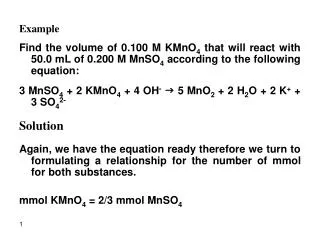
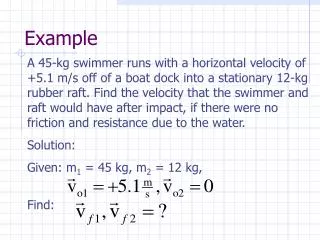
Example A 45-kg swimmer runs with a horizontal velocity of +5.1 m/s off of a boat dock into a stationary 12-kg rubber raft. Find the velocity that the swimmer and raft would have after impact, if there were no friction and resistance due to the water. Solution: Given: m1 = 45 kg, m2 = 12 kg, Find:
Consider motion of boy and raft just before and just after impact • Boy and raft define the system • Neglect friction and air resistance no external forces (which act in the direction of motion) • Therefore, we can use the Conservation of Linear Momentum
Since, the boy moves with the raft after the impact • What if we have the case where vf1 vf2 ? We then have two unknowns. So, we need another equation.
This is the situation discussed in example 7 • We can use Conservation of Mechanical Energy. No non-conservative forces. No change in y – so only KE. • From original conservation of momentum equation, solve for vf2. Then substitute into conservation of energy equation.
Here is a trick! Eq. (7.8a)
Use numerical data from example Momentum is conserved!
Collisions in 2D • Start with Conservation of Linear Momentum vector equation • Similar to Newton’s 2nd Law problems, break into x- and y-components Example – Problem 7.34 Three guns are aimed at the center of a circle. They are mounted on the circle, 120° apart. They fire in a timed sequence, such that the three bullets collide at the center and mash into a stationary lump.
Two of the bullets have identical masses of 4.50 g each and speeds of v1 and v2. The third bullet has a mass of 2.50 g and a speed of 575 m/s. Find the unknown speeds. Solution: Given: m1 = m2 = 4.50 g, m3 = 2.50 g, vo3 = 575 m/s, vf1 = vf2 = vf3 = 0 Find: vo1 and vo2 Method: If we neglect air resistance then there are no external forces (in the horizontal x-y plane; gravity acts in the vertical direction) we can use Conservation of Linear Momentum
y 120 60 x 120 60