
SlideServe
Menu
Préférences
© SlideServe · v2026

Cassava

kibo-morrison avatar
8 diapositives · 817 Views · Nov 09, 2014

Indigenous to South America, and a staple food in many African societies Very tough plant: very drought-tolerant, reproduces by cuttings, grows in marginal soil Nutritional value: high in carbohydrates, but not in protein, and a diet high in cassava can produce malnutrition
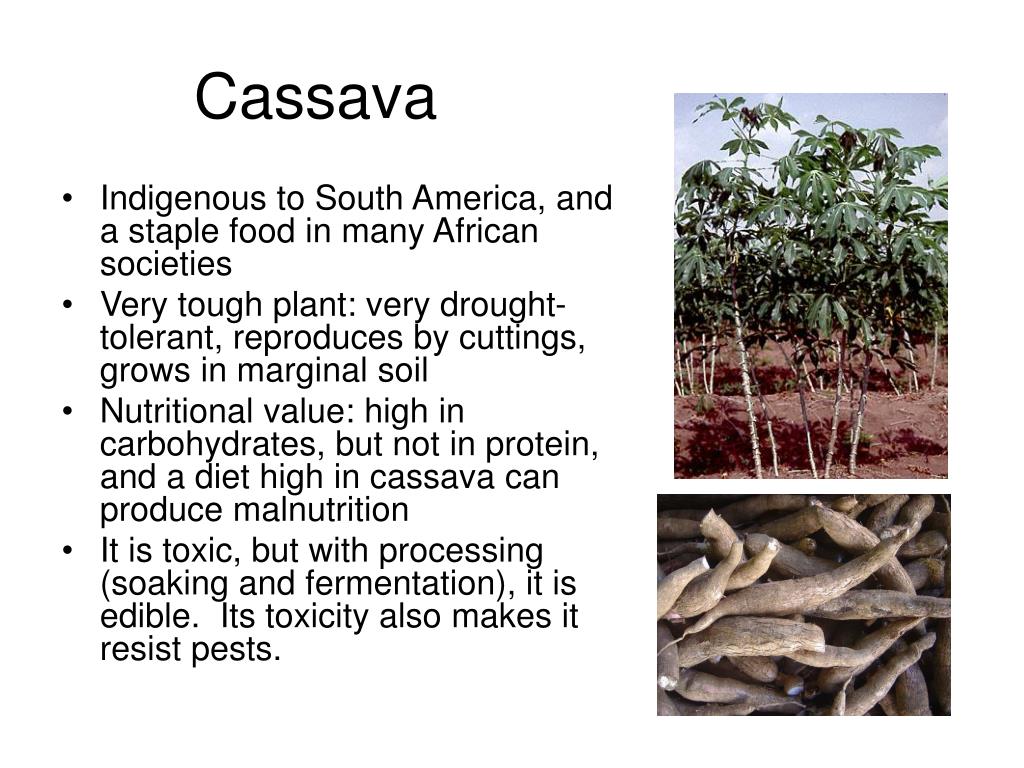
Cassava - slide 1
01 / 8Cassava
1 / 17

Télécharger la présentation

Cassava
Une image / un lien ci-dessous est fourni (tel quel) pour télécharger la présentation

Politique de téléchargement : le contenu du site vous est fourni TEL QUEL pour votre information et votre usage personnel ; il ne peut être vendu, concédé sous licence ni partagé sur d’autres sites sans l’accord de son auteur.Le contenu vous est fourni TEL QUEL, pour votre information et votre usage personnel uniquement. Téléchargez la présentation en cliquant sur ce lien. Lors du téléchargement, si vous ne parvenez pas à télécharger une présentation, l’éditeur a peut-être supprimé le fichier de son serveur.Pendant le téléchargement, si vous ne parvenez pas à obtenir une présentation, le fichier a peut-être été supprimé par l’éditeur.

F I N

Plus de contenu associé

Transcription de la présentation
  1. Indigenous to South America, and a staple food in many African societies Very tough plant: very drought-tolerant, reproduces by cuttings, grows in marginal soil Nutritional value: high in carbohydrates, but not in protein, and a diet high in cassava can produce malnutrition It is toxic, but with processing (soaking and fermentation), it is edible. Its toxicity also makes it resist pests. Cassava

  2. Boro in Twi means from afar/abroad borode = plantain aborobe = pineapple aburo = corn Although--- bankye = cassava Food crops in Ghana brought from South America

  3. Agriculture in Africa • Production of domesticated plants using handheld tools • Rain as the source of moisture • Major crops: grains such as millet and sorghum, and root crops like yam and cassava • Cultivated fields not used permanently, year after year, but remain fallow

  4. Agriculture in Africa • Lower yield per acre than intensive agriculture but less human labor also • Average plot size are less than an acre; 2.5 acres can support 5-8 people a year. • Population densities are low, but villages may be large (100-1,000 people)

  5. Slash-and-Burn Farming • A field is cleared by felling the trees and burning the brush • The burned vegetation is left on the land, preventing drying out of the soil • Ash serves as fertilizer • Very little weeding required because of the ash cover • Fields used for a few years and then allowed to lie fallow (up to 20 years) so that the forest cover can be rebuilt and soil fertility restored

  6. Horticulture and the Environment • So long as the land is allowed to remain fallow until it rejuvenates, the system is sustainable. • However, access to land by ranchers, miners, tourists, and farmers; horticulturalists’ desire to increase production for cash; and population growth can mean that the land becomes degraded.

  7. Agriculturalists & Gender • Men’s and women’s work roles often clearly defined • A common pattern is for women to grow staple crops for food and men to grow cash crops or earn cash through other means • The differences in work roles have implications for the status of men and women.

  8. Agriculturalists & Gender • With an increase in crops grown for sale (cash crops like cotton, cocoa, etc) rather than crops grown for household use (staples or food crops), men tend to dominate in farming • The introduction of the market economy has thus tended to benefit men, not women.