Understanding Exponents, Scientific Notation, Metric Conversion, and Velocity Changes
This chapter delves into the key concepts of exponents, scientific notation, and metric conversions essential for accurate data representation in various fields. It covers rules for manipulating exponents, the transition between scientific and engineering notation, and offers insight into metric and English unit conversions for distance, velocity, and weight. With practical examples and conversion factors, this resource serves as a valuable guide for students and professionals working with numerical data in science and engineering contexts.

Understanding Exponents, Scientific Notation, Metric Conversion, and Velocity Changes
E N D
Presentation Transcript
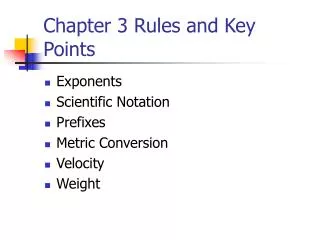
Chapter 3 Rules and Key Points • Exponents • Scientific Notation • Prefixes • Metric Conversion • Velocity • Weight
Rule 3‑1: If we make the exponent more positive, the decimal point moves to the left. Rule 3‑2: If the exponent is made more negative, the decimal point moves to the right. 6700 = 670 X10 = 67.0 X 102 = 6.70 X 10³ 0.00275 = 0.0275 X10‑1 = 0.275 X 10-2 = 2.75 X 10‑3 Exponents
Key Point: Expressing numbers as numbers between 1 and 10 times the proper power of ten is called scientific notation. Expressing numbers as numbers times powers of ten that are multiples of 3 is called engineering notation. 47,000 = 4.70 X10⁴ in scientific notation to three places. 47,000 = 47.0 X 10³ inengineering notation to three places. Scientific Notation
Rule 3‑3: To change numbers with prefixes to regular numbers, replace the prefix with the power of ten that it represents and then change to a regular number. 30 mA = 30 X10‑3 A = 0.030 A 33 k = 33 X 103 = 33,000 Prefixes
Some conversions of linear measure between English and metric are: 1 in = 2.54 cm 1 cm = 0.3937 in 1 yd = 0.9144 m 1 m = 1.094 yd 1 mi = 1.609 km 1 km = 0.6214 mi 20 cm = 7.874 in12 in = 30.48 cm 100 m = 109.4 yd 5 mi = 8.045 km Metric Conversion
The units of velocity are meters/second or kilometers/hour in metric feet/second or miles/hour in English. 15 m/s = 49.22 ft/s Velocity
Common units of weight in metric are the milligram, gram, and kilogram. In the English system, we have the ounce, pound, and ton. 16 oz = 1 lb 1 kg = 35.27 oz 2000 lb = 1 ton 1 lb = 453.6 gm 100 lb = 45.36 kg 100 kg = 220.5 lb Weight