Mastering Dimensional Analysis: A Guide for Students
Dimensional analysis is a powerful problem-solving technique every student can benefit from. It fosters a systematic approach to tackling math problems, reduces algebraic errors, reinforces unit conversion, and enhances comprehension of real-world applications of mathematics. This guide outlines a five-step process for using dimensional analysis effectively, emphasizing understanding over rote memorization. By engaging with various examples, students can improve their problem-solving skills while learning to transform measurements and solve problems in a more logical and insightful manner.


Mastering Dimensional Analysis: A Guide for Students
E N D
Presentation Transcript
Dimensional Analysis Why do it? Kat Woodring
Benefits for students • Consistent problem solving approach • Reduces errors in algebra • Reinforces unit conversion • Simplifies computation • Improves understanding of math applications • Multiple ways to solve the same problem
5 Steps of Dimensional AnalysisUsing the Metric Conversion • Start with what value is known, proceed to the unknown. • Draw the dimensional lines (count the “jumps”). • Insert the unit relationships. • Cancel the units. • Do the math, include units in answer.
Write the KNOWN, identify the UNKNOWN. • EX. How many quarts is 9.3 cups? 9.3 cups = ? quarts
9.3 cups = ? quarts Draw the dimensional “jumps”. 9.3 cups x * Use charts or tables to find relationships
Insert relationship so units cancel. quart 1 9.3 cups x 4 cups *units of known in denominator (bottom) first *** units of unknowns in numerator (top
1 quart 9.3 cups x 4 cups Cancel units
1 quart 9.3 cups x 4 cups Do Math • Follow order of operations! • Multiply values in numerator • If necessary multiply values in denominator • Divide.
9.3 = 4 Do the Math 1 quart 9.3 x 1 9.3 cups x = 4 cups 1 x 4 = 2.325 s
Vocabulary • KNOWN • UNKNOWN • CONVERSION FACTOR • UNITS
Initial and Final Units 1. A person has a height of 2.0 meters. What is that height in inches? Initial unit = m Final unit = _______ 2) Blood has a density of 0.05 g/mL. If a person lost 0.30 pints of blood at 18°C, how many ounces of blood would that be? Initial = pints Final unit = _______ LecturePLUS Timberlake
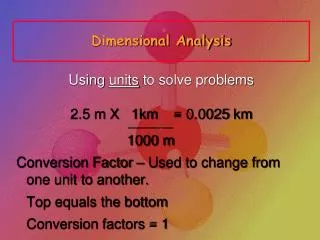
How many minutes are in 2.5 hours? Initial unit 2.5 hr Conversion Final factor unit 2.5 hr x 60 min = 150 min 1 hr cancel Answer (2 SF) LecturePLUS Timberlake
Learning Check An adult human has 4650 mL of blood. How many gallons of blood is that? Unit plan:mL qt gallon Equalities: 1 quart = 946 mL 1 gallon = 4 quarts Your Setup: LecturePLUS Timberlake
Solution Unit plan:mL qt gallon Setup: 4650 mL x 1 qt x 1 gal = 1.23 gal 946 mL 4 qt 3 SF 3 SF exact 3 SF LecturePLUS Timberlake
Write the KNOWN, identify the UNKNOWN. • EX. How many km2 is 802 mm2 ? 802 mm2 = km2?
802 mm2 = km2? Draw the # of dimensional “jumps” 802 mm2 x x x x x x
802 mm2 = km2? Insert Relationships cm2 dm2 m2 dkm2 hm2 km2 802 mm2 x x x x x x mm2 cm2 dm2 m2 dkm2 hm2
cm2 dm2 m2 dkm2 hm2 km2 802 mm2 x x x x x x mm2 cm2 dm2 m2 dkm2 hm2 Cancel Units *Units leftover SHOULD be units of UNKNOWN
cm2 dm2 m2 dkm2 hm2 km2 x x x x x x mm2 cm2 dm2 m2 dkm2 hm2 Cancel Units (1)2 (1)2 (1)2 (1)2 (1)2 (1)2 802 mm2 (10)2 (10)2 (10)2 (10)2 (10)2 (10)2 *Units leftover SHOULD be units of UNKNOWN
cm2 dm2 m2 dkm2 hm2 km2 x x x x x x mm2 cm2 dm2 m2 dkm2 hm2 Do the Math… (1)2 (1)2 (1)2 (1)2 (1)2 (1)2 802 mm2 (10)2 (10)2 (10)2 (10)2 (10)2 (10)2 *What kind of calculator is BEST?
Differences from other math approaches • Solve for variables in equation first, then substitute values • Open ended application • No memorized short-cuts • No memorized formulas • Reference tables, conversion factors encouraged