Assembling Binary Colloidal Structures via Ising Interactions for Advanced Material Fabrication
10 likes | 133 Vues
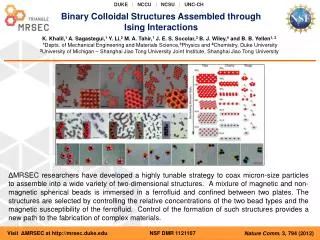
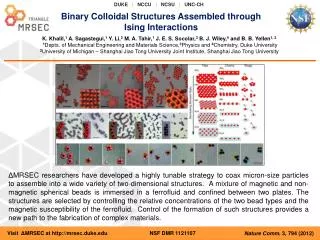
Researchers from Duke University and collaborating institutions have developed a novel strategy to assemble micron-sized particles into diverse two-dimensional binary structures. By utilizing a mixture of magnetic and non-magnetic spherical beads in a ferrofluid and controlling their relative concentrations and the fluid’s magnetic susceptibility, the team can precisely dictate structure formation. This innovative approach opens new pathways for the fabrication of complex materials with tailored properties, advancing the field of material science.


Assembling Binary Colloidal Structures via Ising Interactions for Advanced Material Fabrication
E N D
Presentation Transcript
DUKE | NCCU | NCSU | UNC-CH Binary Colloidal Structures Assembled through Ising Interactions K. Khalil,1A. Sagastegui,1Y. Li,2M. A. Tahir,1J. E. S. Socolar,3B. J. Wiley,4and B. B. Yellen1, 2 1Depts. of Mechanical Engineering and Materials Science,3Physics and 4Chemistry, Duke University 2University of Michigan – Shanghai Jiao Tong University Joint Institute, Shanghai Jiao Tong University ΔMRSEC researchers have developed a highly tunable strategy to coax micron-size particles to assemble into a wide variety of two-dimensional structures. Amixture of magnetic and non-magnetic spherical beads is immersed in a ferrofluid and confined between two plates. The structures are selected by controlling the relative concentrations of the two bead types and the magnetic susceptibility of the ferrofluid. Control of the formation of such structures provides a new path to the fabrication of complex materials. Visit ΔMRSEC at http://mrsec.duke.edu NSF DMR 1121107 Nature Comm. 3, 794 (2012)