Download
1 / 11
120 likes | 240 Vues
This study explores the role of dust in young galaxies through various simulations and analyses. Using advanced Monte Carlo codes, we examine radiative transfer effects, surface brightness maps, and profiles in starburst galaxies at redshifts z = 3 to 6. We analyze the impact of dust created in supernova explosions and the extinction of light in Lyman-alpha galaxies at z = 8. The findings underline significant increases in star formation rates when correcting for dust, highlighting dust's importance in galactic evolution.

E N D
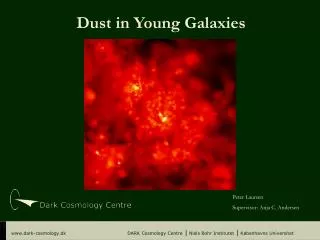
Dust in Young Galaxies Peter Laursen Supervisor: Anja C. Andersen www.dark-cosmology.dk DARK Cosmology Centre| Niels Bohr Institutet | Københavns Universitet
The code • Radiative transfer • Monte Carlo
Results • Surface brightness maps
Results • Surface brightness maps • Surface brightness • profiles
Results • Surface brightness maps • Surface brightness • profiles • Spectra
Dust in Young Galaxies • Star formation • Dust formation • Dust destruction • Radiative transfer
Dust in Young Galaxies • Dust Extinction in Starburst Galaxies at z = 3 – 6 • Dust Creation in Supernova Explosions • Lyman a Galaxies at z = 8.8
Dust Extinction in Starburst Galaxies at z = 3 - 6 • Lyman-Break Galaxies: • SFR = 10 – 1000 M☼ yr-1 • Correcting for dust with Calzetti ext. curve: • SFR increases a factor of 2 – 5
Dust Extinction in Starburst Galaxies at z = 3 - 6 • Advance Monte Carlo code • Predict effect of dust as function of tsf, Z and z • Very young starbursts: No AGBs, intense UV field • Analyze and model SED of LBGs from GOODS • z = 2 – 6; X-rays to mid-IR • and Ultra-VISTA (COSMOS field)
Dust Creation in Supernova Explosions • No AGB stars SNe? • Grain formation and growth in SN remnants
Lyman aGalaxies at z = 8.8 • ~no sky-lines in the near-IR • e.g., l = 1.2 mm • Simulate morphology and SB of statistical sample • Compare with VISTA observations