Geometry Constructions
This guide explores the essence of geometry using formal constructions that rely solely on a compass and straightedge, avoiding human measurement errors. Learn how to create perfect geometric figures such as perpendicular bisectors, angle bisectors, and equilateral triangles, as well as how to circumscribe and inscribe circles around shapes. By employing these techniques, you can achieve precise geometric constructions that are universally applicable, transcending individual numerical values. Unleash your creativity with your compass and uncover the beauty in geometric designs!

Geometry Constructions
E N D
Presentation Transcript
Geometry Constructions Creating Perfect Shapes without numbers
To Err is Human • In mathematics and science when we prove ideas, we are trying to show that it works for every case. To do this we can’t just pick numbers and try it once, but it’s impossible to try it for every number. • Also, we can’t use human measurements of length and degrees. This is because humans aren’t perfect and the tools we use aren’t perfect either.
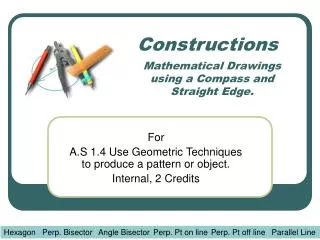
Math without the Numbers • There are some proofs of geometry concepts that can be done with formal constructions. • A formal geometric construction uses only a compass and a straight edge. This removes the use of human measurement and generalizes the proof to work for all possible measures.
Tools of the trade • A Geometry compass is tool that is used for drawing arcs and circles. The most important part of choosing a compass is making sure it will hold it’s position. • Anything with a rigid straight side can be used for a straight edge. I like to use popsicle sticks instead of rulers because they don’t have any numbers to tempt students to cheat on their constructions
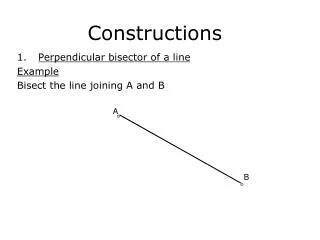
Construction 1 Perpendicular bisector • A perpendicular bisector of a line segment, divides the segment into two equal parts with a perpendicular line. • This construction also can be used to find the midpoint of a line segment.
Constructions 2 and 3 Perpendicular Through a Point • We’ll use the same idea and techniques to make a perpendicular that isn’t the bisector. For the first one the point is on the line segment. For the second one the point is not on the line segment.
Construction 4 Angle bisector • An angle bisector divides an angle into two equal angles.
Construction 5 Copying an angle • To make congruent angles we need to make a copy of an angle.
Construction 6 Equilateral Triangle • An equilateral triangle has three congruent sides and three congruent angles.
Construction 7 Circumscribing • Circum means around and scribe means write. So to circumscribe a circle around a triangle means to draw a circle around the triangle. • To do this we will be making • perpendicular bisectors of • the sides of the triangle.
Construction 8 Inscribing • This time we’re going to construct a circle inside the triangle.
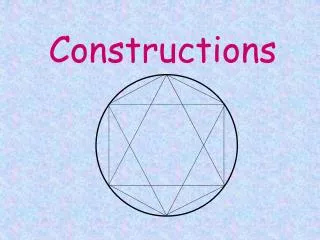
Construction 9 Hexagons • Because circles have 360 degrees they are easily separated into six segments. This is why hexagons are often found in nature, like basalt columns, honeycombs and crystals.
hexagons This method can also be used for making an equilateral triangle By just connecting every other mark.
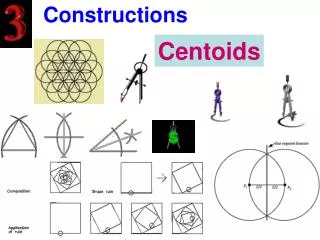
What Else can you make with your compass? Flower of Life drawing from one of Leonardo DaVinci’s sketchbooks.