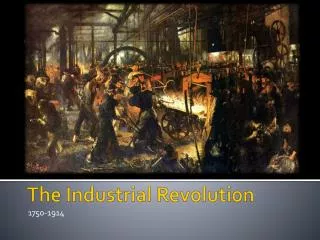
The Industrial Revolution
160 likes | 283 Vues
The Industrial Revolution, occurring from 1750 to 1914, marked a profound transformation in technology and society, characterized by a significant acceleration in innovation and the rise of new energy sources. Beginning in Western Europe, particularly Britain, this era led to increased production capabilities and global dominance. Factors facilitating this revolution included competitive states, support for the merchant class, and access to natural resources. It resulted in changing social classes, innovation in industries like textiles and railroads, and a rise in urbanization, impacting workers and leading to movements for rights and reforms.


The Industrial Revolution
E N D
Presentation Transcript
1750-1914 The Industrial Revolution
What was the Industrial Revolution? • great acceleration in rate of technological innovation, leading to an enormously increased output of goods & services • new sources of energy • a culture of innovation • widespread & almost obsessive belief that things could be endlessly improved • put W.Europe into position of global dominance • only nations that industrialized had chance to compete w/ W.Europe • spread unevenly & is a continuing process • “developed”, “developing”, “undeveloped” nations
Why did the Industrial Revolution begin in Western Europe? • preceded by Scientific Revolution • numerous small, competitive states • governments supported merchant class • govts needed revenue they provided • encourage innovation & commerce • global contact w/culturally different people • bring back foreign goods as stimulus • ex. Indian cotton cloth, Chinese porcelain • can draw on world’s natural resources
Why did it begin in Britain? • unplanned & unexpected, c1750 • factors of production were ideal • large labor force (unemployed farmers) • farmlands “enclosed” & agricultural innovations • infrastructure: road & canal networks • geographic luck • coal & iron ore, protection from conquest stability • global empire provided natural resources • government pro-capitalist • limited monarchy
Industrialization spreads from Britain in early 1800s Britain Germany, France, Belgium USA
Industrial Society • constant innovation STEAM LOCOMOTIVE JAMES WATT’S STEAM ENGINE THE POWER LOOM THE STEAMBOAT
Rapid Economic Growth British Pig Iron Production: 1750-1870 • British Cotton Textile Production: • 1800: 52,000,000 lbs. cotton used • 1850: 588,000,000 lbs cotton used Coal Mining Output & Laborers in Britain: 1800-1914
Rise of the Railroad: 1840-1900 Length of Railroad Lines Open (in kilometers)
Changing Social Classes • The Aristocracy • owned most farmland & dominated politics • rivaled by industrialized businessmen • many became settlers or administrators in overseas colonies • The Middle Class • Self-made factory & mine owners, bankers, merchants • live aristocratic life • central value = respectability
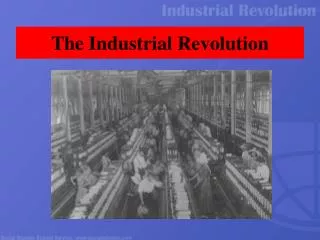
Changing Social Classes • The Laboring Class • manual workers • impacted most by new urbanization • majority of British population in cities • overcrowded, unsanitary, periodic epidemics, tenement housing, inadequate water supply, few public services • factory system: • workers produce manufactured goods in one place using machines for regular wage • long hours, low wages, monotonous labor, dangerous • children & young women oftentimes used
Challenging the New Social Order • Luddites • movement for working man’s vote • women’s rights & suffrage movement • trade unions develop • socialist & utopian ideals form & spread • challenge capitalist society & social problems it developed • “Marxism”
Communism: Rethinking Industrial Society • Communism (“Marxism”) • Karl Marx • The Communist Manifesto, 1848 • history is the story of class struggle • oppressor vs. oppressed • bourgeoisie vs. proletariat • Marx’s observations: • under capitalism, the industrial workers are exploited by their bosses • Goal of communism? • Abolish capitalism & class system! • How? • Revolution of workers & redistribute wealth evenly • No private property; all is shared in the workers’ paradise!