The Articles of Confederation and the Formation of the U.S. Constitution
The Articles of Confederation, initiated in 1777 and ratified by all 13 states in 1781, served as the first constitutional framework for the United States, emphasizing state sovereignty. However, its weaknesses—such as lack of a central government, tax authority, and military—became evident. In 1787, the Philadelphia Convention convened, led by George Washington, to revise this system. They drafted the Constitution, balancing power between state and federal governments, establishing a president, and granting Congress the authority to tax and regulate trade.

The Articles of Confederation and the Formation of the U.S. Constitution
E N D
Presentation Transcript
Articles of Confederation And the Constitution
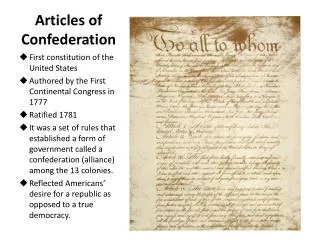
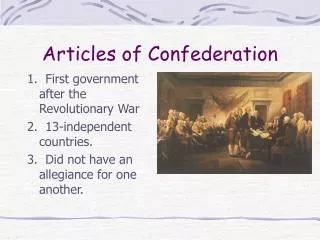
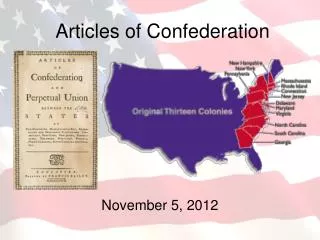
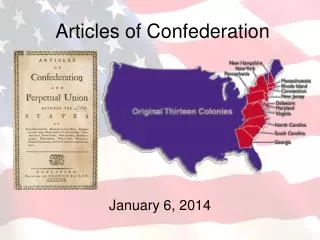
Articles of Confederation • Started in 1777 • It was a plan to join the states together • It gave the 13 states a plan for government • The articles were popular because it did not make the national government too strong • It was approved by all 13 states in 1781
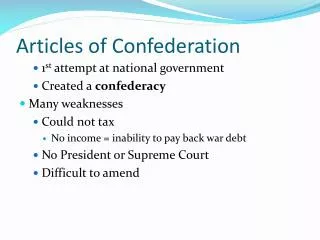
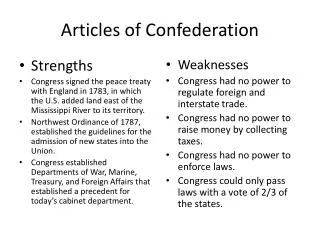
T- Chart (Articles of Confed.) • 1781-1787 • States have the most power • No president • State courts only- no national courts • Congress has no power to tax • Congress cannot regulate trade among states • States have own money • No military • No treaties with other countries • States all had to agree to changes
The Convention • 55 delegates attended • Held in Philadelphia, Pennsylvania • 1787 • Well-educated men • George Washington was the leader • Delegates were important people from the other states • They shared the same ideas about the government
Security at the Convention • Doors to the State House were guarded • Only delegates were allowed inside • They were not allowed to discuss things with outsiders • Their meetings were private and secret from the public
What were they trying to do? • The delegates were trying to revise the Articles of Confederation; a new plan of government was needed • 9 out of 13 states had to approve it • On September 17, 1787 the delegates agreed and signed the Constitution
Constitution (T-Chart) • States have some power, most power given to nat. govt • President • Military w/ president in charge • National and state courts • Laws passed by majority vote of both houses of Congress • Congress has power to tax • Congress has power to regulate interstate and foreign trade • National Money • Bill of Rights