Download
1 / 12
130 likes | 253 Vues
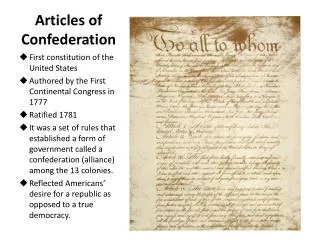
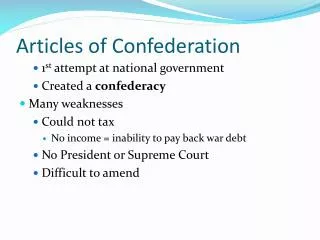
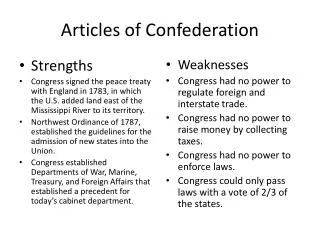
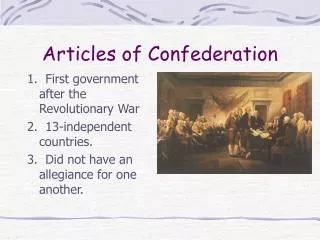
In 1776, New Hampshire became the first colony to organize as a state, leading to the creation of state constitutions and a government structure. The Articles of Confederation were established in 1781 as the first constitution of the United States, creating a loose alliance of states with a weak central government lacking power to enforce laws or tax. The government's inability to manage debt and societal unrest, highlighted by Shays' Rebellion, revealed critical weaknesses. These challenges spurred the 1787 Constitutional Convention to revise the Articles, ultimately leading to the creation of a new Constitution.

E N D
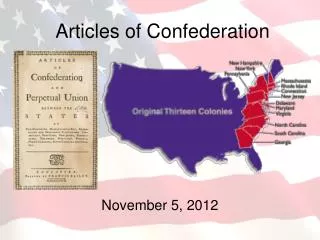
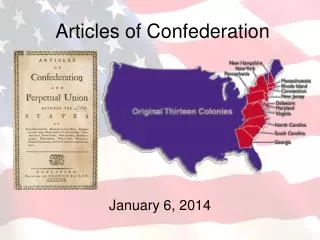
Articles of Confederation January 6, 2014
January 1776 • New Hampshire 1st colony to organize as a STATE • Create state Constitution • Constitution: detailed, written plan Each state gov’t similar • Legislature: create laws • Bicameral: 2 houses • 1 Governor for each state • Carry out the laws • Judges/ courts • Decide if laws fair/ what laws mean
Each state had: • Trial by jury • Protection of Personal Property But…One thing can’t do: • Create a LARGE army • 13 small armies would be no match for the British May 1776: 2nd Continental Congress • Goal: create a UNION of states • Create the Articles of Confederation • 1st Constitution of the U.S. • Confederation: group of individual state gov’ts that BOND together (cooperate)
1781: All 13 states ratify • Ratify: APPROVE Articles of Confederation • 1 house Legislature • Each state gets 1 vote Only Government can deal with: • Army • Deal with foreign countries But…Government cannot: • Enforce laws • Tax (can only ask, no demand) • Government cannot ask states to do anything
Weakness of Articles of Confederation • No pass law without 9 of 13 states agree • To Amend (change) articles • Need all 13 states • No enforce laws • No single leader • No court system • No tax • 1783: U.S. wins Revolutionary War against England • Treaty of Paris ends war • Major Problem: DEBT HIGH • Government cannot TAX
States increase taxes • Tax goods from other states • Farmers can’t pay for property • Leads to Resentment • 1786-1787: riots break out • Fear gov’t no protect safety Daniel Shays (Shays’ Rebellion) • Farmer from Massachusetts • State threaten to take farm • Gather 1,200 farmers & riot • Wake-up Call: NEED stronger gov’t • 1787: 12 states send delegates to Philadelphia to REVISE Articles
American Revolution • Few people live west of Appalachian Mountains • By 1790s: 120,000 people • Government works to survey (measure) land & sell • Creates 6 square mile townships • Each township broken up to 36 sections of 1 square mile each • PROBLEM: How to govern area • Northwest Ordinance created to govern • No Slavery
Constitutional Convention January 28, 2014
1787: Constitutional Convention • Rhode Island only state that didn’t send delegates • Don’t want strong national gov’t • May 25, 1787: Meet in Independence Hall, Philadelphia • Bad weather Delegates • 55 men • Well educated • Lawyers, doctors, merchants, college presidents, generals, governors • 8 signed Declaration of Independence • 7 were governors • 41 member of Continental Congress
NO • African Americans • Native Americans • Women • Ben Franklin oldest (81) • Famous writer, inventor, scientist • George Washington & James Madison become U.S. Presidents • Thomas Jefferson & John Adams in EUROPE • Patrick Henry against/ no go
Chose George Washington to preside over Constitutional Convention • Leadership during American Revolution 1. Each state get 1 vote • No matter how many delegates 2. Majority decides (7 votes) 3. Held in SECRET • No one knows; no records • James Madison notebook only source of information • GOAL: REVISE Articles • But…end up writing NEW CONSTITUTION