Download
1 / 8
80 likes | 185 Vues
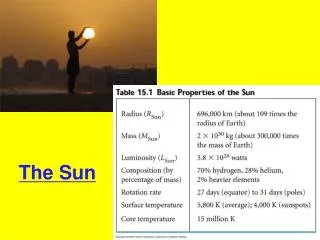
The Sun is a massive star at the center of our Solar System, composed primarily of 75% hydrogen and 25% helium. Formed 4.5 billion years ago, it engages in nuclear fusion at its core, a process that converts hydrogen into helium while releasing significant amounts of energy, heat, and light that sustain life on Earth. The Sun's core reaches temperatures of about 10 to 22.5 million degrees Fahrenheit, with surface temperatures around 9,900°F. Understanding the Sun's structure and function is crucial for appreciating its role in our universe.

E N D
Introduction to The Sun • Our sun is a star located at the center of our Solar System. It is a huge, spinning ball of hot gas and nuclear reactions that light up the Earth and provides us with heat. The Greeks called the Sun "Helios"; the Romans called it "Sol."
COMPOSITION OF THE SUN • The Sun is made up of gases. It is composed of about 75% hydrogen and 25% helium. About 0.1% is metals ). • The Sun formed 4.5 billion years ago
THE TEMPERATURE OF THE SUN • The Sun's core can reach 10 to 22.5 milliondegrees Fahrenheit. The surface temperature is approximately 9,900°F. The outer atmosphere of the Sun gets extremely hot again, up to 1.5 to 2 million degrees. • The temperature of the Sun is determined by measuring how much energy (both heat and light) it emits.
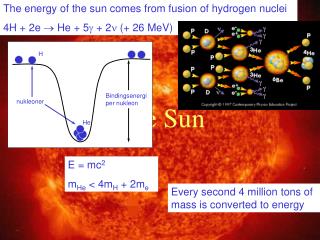
The Sun’s ENERGY PRODUCTION • At the Sun's core the changing hydrogen into heliumproduces large amounts of energy. This is called nuclear fusion. • Nuclear fusion releases an enormous amount of this heat and light energy into the Solar System (including Earth).
AGE OF THE SUN • The Sun formed 4.5 billion years ago, as the solar system coalesced from a cloud of gas and dust.
1. Is the Sun a star, a planet, or a nebula?_______________________ 2. Is the Sun solid, liquid, or gaseous ?_______________________ 3. What did the Greeks call the Sun?________________________4. Where is the Sun hottest?_______________________ 5. Where is the Sun coolest?_______________________ 6. What element is there the most of on the Sun?_______________________ 8. What is the name for what happens when the Sun changes hydrogen atoms into helium atoms? _______________________ 9. How old is the Sun? ______________________